Glacier Webcams: Check Logan Pass Conditions Before You Drive
The National Park Service and the Glacier National Park Conservancy provide official and partner-supported webcam views around Glacier National Park, including areas such as Apgar, Lake McDonald, and Logan Pass. Use them to gauge visibility, weather, and how busy a parking area looks, but treat the image as a snapshot rather than a guarantee. Pair the cameras with NPS Logan Pass information and current road or trail status before you drive.
TL;DR:
- Glacier Park webcams update approximately once every 60 seconds and are not continuous streams, so check timestamps to verify current conditions.
- A full parking lot visible on webcam early in the morning does not guarantee parking availability later in the day, especially during peak season.
- The Logan Pass webcam is the most frequently checked, but snow and weather conditions visible there can persist well into summer despite the road opening date.
- The 2026 Logan Pass shuttle and three-hour timed-parking program ran from July 1 through September 7. As of September 23, both seasonal measures have ended; parking is first-come, first-served without that seasonal time limit until the alpine road section closes for winter.
- Cross-reference webcam images with official NPS condition pages for accurate road and parking status, especially when planning a tight schedule.
GlobewebcamsSee Glacier Conditions Before You GoExplore live webcam views of scenic destinations, weather, snow, surf, beaches, roads, cities, and landmarks in one place.Explore live webcams
Table of Contents
- Where to Find Glacier Webcams (And What Each One Shows)
- How Do Glacier Webcams Actually Update?
- How Should You Use Webcams to Plan a Visit?
- Which Cameras Are Best for Wildlife, Snow, or Night Sky?
- Where Should You Actually Watch These Feeds?
- How I Use Glacier Webcams Before a Day Trip
- Sources
- FAQ
Where to Find Glacier Webcams (And What Each One Shows)
Glacier National Park’s webcam network is small but strategically placed. Most cameras sit at high-traffic pinch points, entrances, and viewpoints where visitors need real-time information most.
- Apgar Mountain: An elevated view over Lake McDonald and the park’s west side, good for checking cloud cover and general visibility before you commit to a drive up Going-to-the-Sun Road.
- Lake McDonald: Shows lake conditions, reflections, and early wildfire smoke if it’s drifting through the valley.
- Logan Pass: The camera visitors check most. It shows the parking area, snow lingering on the pass, and whether fog is socking in the alpine section. This is one of the Conservancy-hosted views that update roughly once a minute.
- Many Glacier: Also supported through the Conservancy partnership, this view is popular for spotting bears, moose, and bighorn sheep near the valley floor.
- Two Medicine: A quieter camera on the park’s east side, useful for gauging whether that side of the Divide has clearer skies than the west.
- St. Mary: Home to the Dusty Star Observatory sky camera, which merges rapid still images into a night-sky video feed. Check it on clear, moonless nights.
- West Entrance: A direct read on entrance-line traffic, handy for deciding whether to arrive earlier than planned.
- Park Headquarters: A shoreline and valley view near park operations, often used to check general weather trends for the west side.
Most of these are maintained directly by the NPS, while others exist because Conservancy donors fund the equipment and bandwidth. Logan Pass and Many Glacier lean on that partnership, which matters if a camera goes dark. It’s not always an NPS outage. Sometimes it’s a funding or hardware issue on the Conservancy’s end.
How Do Glacier Webcams Actually Update?
Almost none of these cameras stream continuously. They’re periodic snapshot systems, typically refreshing about once every 60 seconds, not a live video feed you can watch scroll in real time. That distinction trips up a lot of first-time visitors who expect something closer to a security camera feed.
The reason comes down to geography. These cameras sit in remote, high-elevation terrain where power and connectivity are genuinely hard to deliver. Many run on solar panels and depend on satellite or microwave uplinks rather than buried fiber, and each of those links is a potential failure point. A storm, a dead battery, or a knocked-loose antenna can all take a camera offline for hours or days.
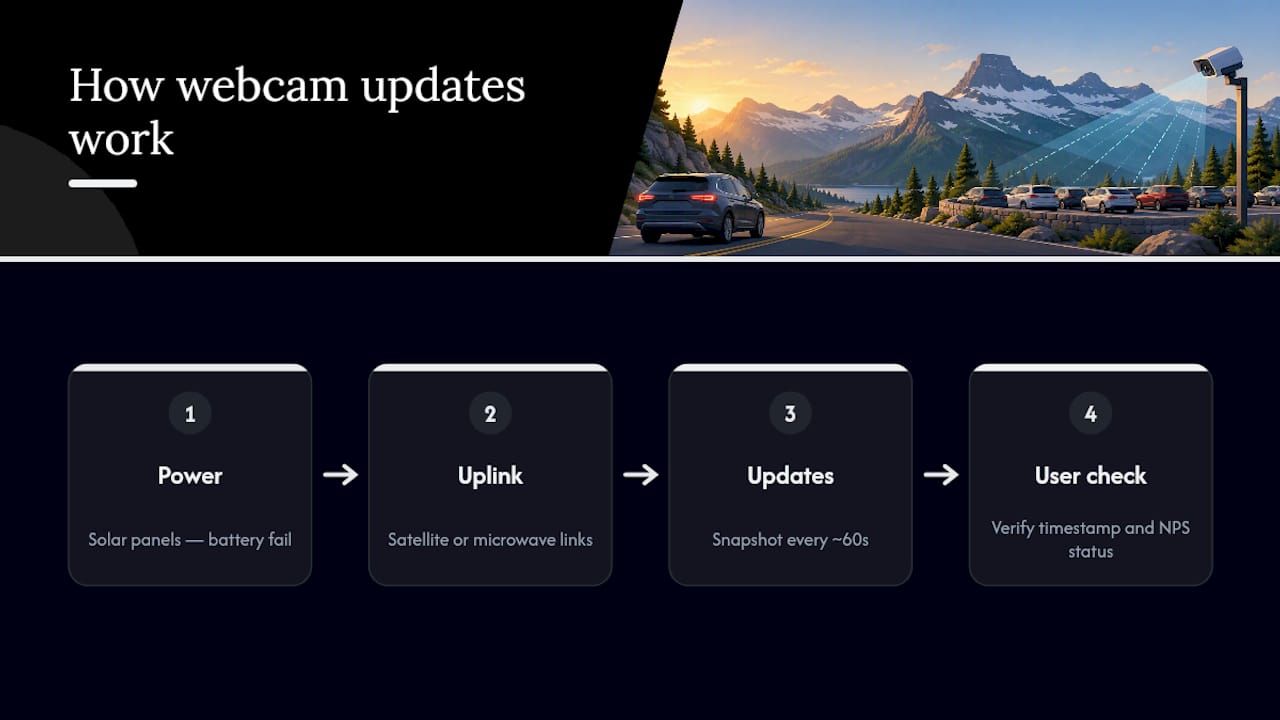
Before you trust an image, check its timestamp. If a camera hasn’t refreshed in an unusually long stretch, or the same frame is stuck across multiple visits, treat it as offline rather than assume conditions haven’t changed. The Conservancy notes that its remote cameras can and do drop out, and that’s expected behavior for equipment bolted to a mountainside, not a sign something is broken with the park itself. When in doubt, cross-reference with the NPS status pages rather than relying on one static frame.
How Should You Use Webcams to Plan a Visit?
Here’s a simple four-step routine for checking conditions before a day trip:
- Check the West Entrance and Logan Pass cameras first thing in the morning to get a visual read on traffic and alpine visibility.
- Check the current parking rules, not just the camera. The three-hour Logan Pass parking limit applied from July 1 through September 7, 2026. The NPS confirmed after the seasonal program ended that parking returned to first-come, first-served without that time limit. A webcam can show whether the lot looks busy, but it cannot guarantee a space when you arrive.
- Check whether the shuttle is actually operating for your date. The 2026 Logan Pass Shuttle was ticketed during its July 1-September 7 operating season and carried a $1 processing fee. That 2026 seasonal service has now ended, so do not rely on the shuttle as a current fallback after September 7.
- Pack for alpine weather even when valley conditions look mild. Going-to-the-Sun Road was opened for the 2026 summer season in late June, but conditions at elevation can change quickly and the alpine section eventually closes for winter. Check the current NPS road status rather than assuming a webcam image means the road is open.
Pro Tip: Check the Logan Pass cam again right before you leave your hotel or campground, not just the night before. Conditions and parking fill up fast, and a fresh look can save you a wasted drive up the pass.
During July 1-September 7, 2026, the three-hour parking window was an important part of the Logan Pass traffic plan. That seasonal restriction has now ended. The underlying caution still applies: a webcam showing an empty lot at one moment says nothing about whether a space will be available by the time you arrive.
Which Cameras Are Best for Wildlife, Snow, or Night Sky?
Different cameras reward different goals, and picking the right one saves you from staring at an empty frame for no reason.
- Wildlife: Many Glacier and the Park Headquarters shoreline camera are your best bets for spotting bears, elk, or moose near the water’s edge, especially early morning and dusk.
- Alpine snow tracking: Logan Pass is the camera to watch if you’re gauging how much snowpack remains before a hike, since it sits right at the highest point of Going-to-the-Sun Road.
- Night sky: The Dusty Star Observatory camera at St. Mary stitches still frames into a night video, best viewed on clear, moonless nights when the Milky Way is visible over the eastern side of the park.
Seasonal cues help too. Early spring cameras often show plowing progress on Going-to-the-Sun Road before it officially opens. Late-season cams reveal how much snow has stuck around at elevation. And because the Continental Divide splits the park’s weather patterns, checking a west-side camera like Apgar alongside an east-side one like St. Mary often paints a fuller picture than either alone.
Where Should You Actually Watch These Feeds?
The NPS webcam page and the Conservancy’s webcam hub are the two primary sources, and both are worth bookmarking directly.
- For a faster way to scan multiple views at once, a map-based aggregator like the GlobeWebcams directory lets you jump between cameras without hunting through separate agency pages.
- Whichever source you use, note the timestamp on every image and don’t lean on a single feed as your only confirmation of road or parking status.
- If you’re checking from your phone at a trailhead or pullout, remember cell coverage inside the park is patchy. Visitor centers generally offer the most reliable Wi-Fi for a quick webcam check.
How I Use Glacier Webcams Before a Day Trip
A practical routine is to check the West Entrance and Logan Pass cameras first, then open the official NPS road and access information for the same day. A clear camera frame does not mean the road is officially open, and seasonal parking or shuttle rules can change. As of September 23, 2026, the summer shuttle and three-hour Logan Pass parking limit have ended for the season, so current road access and parking availability matter more than summer ticketing.
Sources
- Glacier National Park Webcams - Glacier National Park (U.S. National Park Service)
- Visiting Logan Pass 2026 - Glacier National Park (U.S. National Park Service)
- Logan Pass Shuttle Service 2026 - Glacier National Park (U.S. National Park Service)
- Glacier Webcams - Glacier National Park Conservancy
- Going-to-the-Sun Road Open for the 2026 Season - Glacier National Park (U.S. National Park Service)
Want a quicker way to browse Glacier’s cameras alongside thousands of others worldwide? The GlobeWebcams map lets you scan live feeds by location without bouncing between separate agency sites, and it’s a handy way to check conditions at a glance before you commit to a drive.
FAQ
How Often Do Glacier Webcams Update?
Most Glacier cameras update roughly once every 60 seconds rather than streaming continuous video. Always check the timestamp on the image before assuming it reflects current conditions.
Can Webcams Guarantee Parking at Logan Pass?
No. Parking remains first-come, first-served with a three-hour limit from July 1 to September 7, 2026, and a webcam only shows a single moment in time. Treat it as a strong hint, not a booking.
Are Any Glacier Webcams True Livestreams?
Nearly all are periodic snapshot cameras, not continuous livestreams. The one exception in spirit is the Dusty Star Observatory sky camera, which merges frequent stills into a night-sky video sequence.
Where Do I Check Official Road Closures Instead of a Webcam?
Check the NPS Current Conditions and Logan Pass FAQ page for official road, trail, and parking status. The Going-to-the-Sun Road season announcement is also the authoritative source for opening dates.
Do I Need a Shuttle Ticket for Logan Pass in 2026?
Not now. The ticketed 2026 Logan Pass Shuttle operated from July 1 through September 7 and carried a $1 processing fee. That seasonal service has ended for 2026, so check the current NPS access information rather than trying to buy a shuttle ticket for a post-season visit.