Find Reliable Live Nature Webcams Worldwide: 5 Step Checklist
Live nature webcams are publicly accessible camera feeds, usually run by parks, wildlife agencies, or universities, that show wildlife and natural landscapes as they happen or in near real time. The fastest way to start watching is to open a curated discovery map or an official host’s page and pick a feed by species or place. Expect the footage to be unedited: nature does not pause for an audience.
TL;DR:
- Many wildlife webcams operate on limited bandwidth, often switching between live streams and periodic still images instead of continuous video.
- Always verify the feed’s source to ensure it is maintained by a credible organization such as a park, university, or research institute.
- Timing is crucial since peak activity for diurnal animals occurs around dawn and dusk, while nocturnal animals are best viewed with infrared lighting after sunset.
- Natural events like predation and nesting failures are common and unedited, so viewers should be prepared for potentially upsetting content.
- GlobeWebcams simplifies finding reliable nature cams through map and category filters, linking directly to original hosts to avoid outdated or rehosted streams.
GlobeWebcamsFind Nature Webcams You Can TrustBrowse nature webcams by location and category, then follow links back to original providers through GlobeWebcams.
- ✓Browse webcams by location and country
- ✓Filter by nature and scenic categories
- ✓Follow links to original providers
Table of Contents
- Where to find reliable live nature webcams
- What to expect when watching live wildlife cams
- Best times, seasons and species for live viewing
- Technical and access considerations
- Educational, research and conservation value of webcams
- How to choose a webcam to watch right now
- GlobeWebcams: how the platform helps you discover nature cams
- Sources
- FAQ
Where to find reliable live nature webcams
The quickest route to a good feed is a map-based directory that lets you filter by place, habitat, or species rather than scrolling through random search results. GlobeWebcams, for instance, organizes public webcams by country, category, and location, which makes it easier to jump straight to nature or raptor cams instead of wading through traffic and city feeds.
That said, the directory is only a starting point. The feed itself should come from a credible original host, since agencies and research institutions tend to maintain their equipment, disclose outages, and explain what viewers are seeing. A few examples show what that looks like in practice. Montana Fish, Wildlife & Parks runs the Spring Meadow Lake Osprey Cam, a live, unedited feed built for education and research. The University of Minnesota Landscape Arboretum hosts a similar osprey cam that documents nesting activity through the season.
When you find a cam worth watching, look for a few markers of a trustworthy source:
- The page names the hosting agency, park, or institution, not just a generic “wildlife cam” title.
- The feed links back to the original provider rather than rehosting the video with no attribution.
- The host explains basic ground rules, such as whether staff intervene during natural events.
Some webcam directories apply this logic when building their pages, linking back to original providers rather than presenting third-party footage as their own.
What to expect when watching live wildlife cams
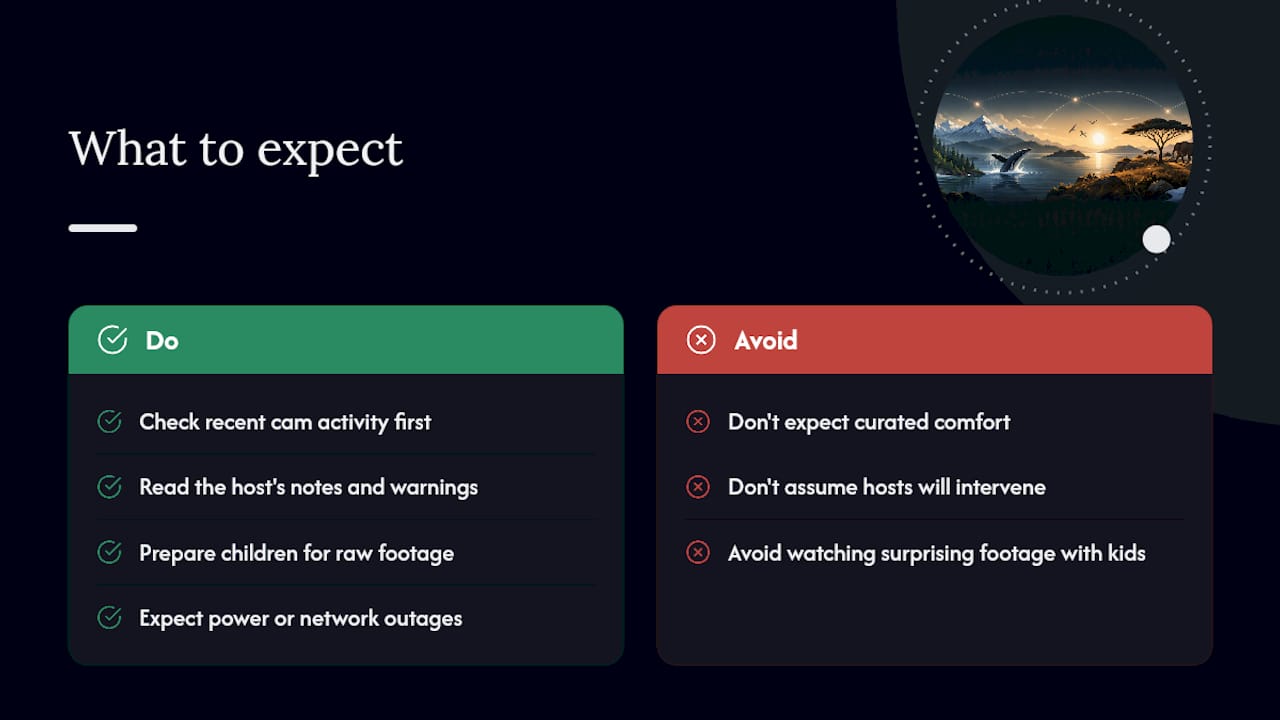
Wildlife cams show nature without a script, and that includes moments that can be hard to watch. Predation, sibling competition, illness, and failed nesting attempts all show up on live feeds, and most hosts choose not to intervene. Montana Fish, Wildlife & Parks states plainly that its osprey cam is live and unedited, and that staff will not step in during natural processes such as predation or competition between siblings, reserving intervention for cases of human-caused harm.
That is the tone the University of Minnesota Landscape Arboretum sets for its osprey cam, which also warns that the feed can go dark due to power or network outages. If you are new to wildlife cams, it helps to know this going in: a nest cam is not curated for comfort. First-time viewers, especially those watching with children, may want to check a cam’s recent activity or read the host’s notes before settling in, so a sudden turn in the footage does not come as a shock.
Best times, seasons and species for live viewing
Timing matters more with wildlife cams than with most webcams, since animals follow their own calendars. Nesting birds like ospreys are most active during breeding and hatching season, when parents are flying in and out with fish and chicks are visible in the nest. Migration windows offer a second burst of activity for many bird cams, while mammal cams tend to follow feeding and denning patterns tied to the local season.
Daily timing matters too:
- Diurnal species, including most raptors, are easiest to catch around dawn and dusk when feeding activity peaks.
- Nocturnal species require infrared-equipped cams; the Barn Owl Live Cam from NC Wildlife notes that barn owls become active after sunset and are visible thanks to infrared lighting.
- Many host pages archive timelapses or highlight clips, which is the fastest way to check whether a nest or den is active before you commit to watching live.
Pro Tip: Check a cam’s host page for a recent activity log or nesting update before you settle in, since a quiet feed at the wrong hour can look identical to an inactive one.
Technical and access considerations
Not every “live” cam streams continuous video. Many remote sites, especially in forests or backcountry parks, run on limited bandwidth and switch to periodic still images instead. The H.J. Andrews Experimental Forest program documents exactly this trade-off, publishing once-per-minute images and timelapses rather than a constant stream when bandwidth cannot support it.
A few things to try if a feed looks stuck or silent:
- Refresh the page, since some cams update on a fixed interval rather than streaming continuously.
- Check whether the host lists a status page or known outage notice before assuming the cam is broken.
- Look for an alternate camera angle or an archived timelapse if the live view is temporarily down.
Audio is often missing too, usually for privacy or bandwidth reasons rather than technical failure. Night vision relies on infrared LEDs, and hosts choose between “no-glow” and “low-glow” infrared depending on how much illumination range they need versus how visible the light is to the animals themselves, a trade-off described in trail-camera lighting guidance.
Educational, research and conservation value of webcams
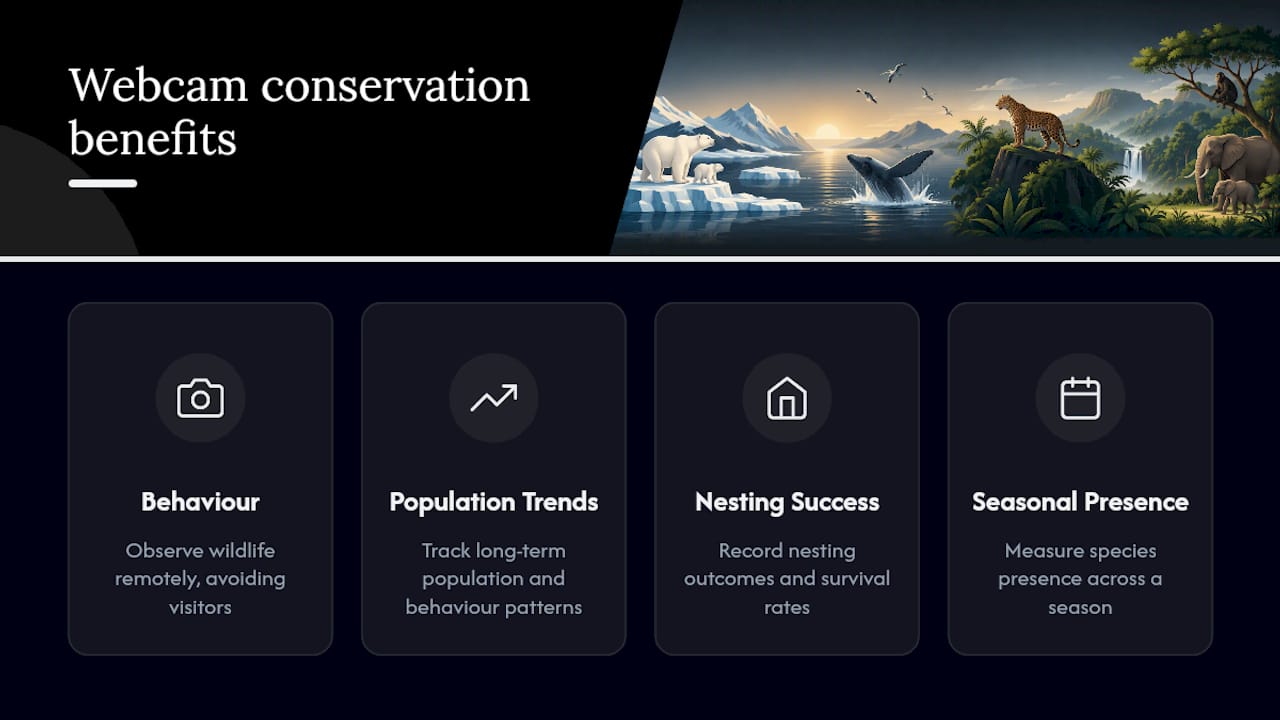
Webcams do more than entertain. Parks Canada describes camera monitoring as a way to observe wildlife behavior and population trends remotely, without adding human presence near sensitive sites. That matters for species that are easily disturbed by visitors, since a camera can track nesting success, seasonal presence, and long-term behavior patterns that would otherwise require repeated field visits.
For the public, the same feeds double as an open classroom: watching a nest through an entire season teaches more about survival rates and parental behavior than a textbook chapter. The ethical rule for viewers is simple: appreciate the feed, but do not attempt to visit the physical camera site or approach the animals in person. If a host page includes a way to report suspicious or harmful human activity near a nest or den, use it. That reporting channel is often the most concrete way a viewer can support the animals being watched.
How to choose a webcam to watch right now
A quick checklist keeps the search short:
- Match the species or place you want to watch, whether that’s ospreys, owls, or a coastal habitat.
- Confirm the host is a credible source, such as a park, agency, or university.
- Check whether the feed is continuous video or periodic stills, so you know what to expect.
- Look for a known activity window, like breeding season or dusk hours for nocturnal species.
- Bookmark a second or third cam in case your first choice is quiet or temporarily down.
Watch for red flags: a page with no named source, an outage that stretches on with no explanation, or a rehosted stream that never links back to the original provider. Any of those suggests the feed is not being maintained the way the original host intends.
GlobeWebcams: how the platform helps you discover nature cams
Finding a working, well-sourced nature cam usually takes more effort than it should, since footage gets rehosted, links go stale, and generic search results bury the agency pages that actually maintain the cameras. GlobeWebcams cuts that search down with map-first browsing and category filters for nature, raptors, beaches, and mountains, so you can go straight to the kind of view you want.
- Browse by country, place, or category instead of guessing at search terms.
- Every listed cam links back to its original host, whether that’s a park service, university, or research program.
- Pages may go through source and availability checks before publishing, aiming to reduce outdated or dead links.
Start at the Worldwide Webcam Map to browse nature cams by place or category, or read the sources page to see how attribution and availability checks work behind each listing.
Sources
For ongoing viewing, follow the original hosts directly: Montana Fish, Wildlife & Parks, the University of Minnesota Landscape Arboretum, the H.J. Andrews Experimental Forest program, and Parks Canada all maintain active wildlife camera pages with updates and seasonal notes. GlobeWebcams’ sources page explains how the platform verifies and credits these providers.
- Spring Meadow Lake Osprey Cam | Montana FWP
- Ospreycam | H.J. Andrews Experimental Forest
- Cameras for monitoring | Parks Canada
- Live Osprey Cam | University of Minnesota Landscape Arboretum
FAQ
Are live nature webcams actually real time?
Most are close to real time, though some run on a short delay or refresh as still images every minute or so due to bandwidth limits, as documented by the H.J. Andrews Experimental Forest program. Check the host’s own description of the feed type before assuming it is continuous video.
Will wildlife agencies intervene if an animal is in danger on camera?
Generally no, unless the danger is caused by humans. Idaho Fish and Game states on its osprey camera page that staff will only intervene for human-caused harm, such as entanglement in debris, and otherwise let natural events unfold.
Why do some nature cams have no sound?
Hosts frequently disable audio for privacy or bandwidth reasons rather than because of a technical fault. This is a common limitation noted across university and agency camera pages rather than an exception.
What is the best time of day to watch a wildlife cam?
It depends on the species: diurnal animals like most raptors are most active around dawn and dusk, while nocturnal species such as barn owls become active after sunset and are visible through infrared lighting, as NC Wildlife notes for its Barn Owl Live Cam. Checking a host’s activity notes before you tune in saves time during quiet hours.
How does GlobeWebcams help me find nature webcams?
GlobeWebcams organizes public webcams by country, category, and place on an interactive map, making it easier to locate nature and wildlife feeds without searching site by site. It links back to the original hosting agency or institution rather than rehosting the footage itself.
Recommended
- Offenbach-Wetterpark DWD webcam — Offenbach
- Rostock-Warnemünde DWD webcam — Warnemünde
- Wasserkuppe DWD webcam — Poppenhausen
- Schmücke DWD webcam — Schmiedefeld am Rennsteig
Webcam availability and conditions can change without notice. GlobeWebcams does not operate most listed cameras; feeds and imagery remain under the control of their original providers. Do not rely on webcam imagery alone for weather, road, travel or safety decisions.