Rainforest Webcams: Where to Watch and How to Check
Rainforest webcams give you a window onto canopy, wildlife, waterfalls and mist without the flight. They fall into a few types: research canopy cameras, museum exhibits, park wildlife cams and scenic waterfall views. Most are run by universities, parks and conservation groups, not by directories like ours. Many run only in season, so the first thing to check is whether a given feed is streaming right now. This guide covers what each type shows, a few well-documented examples, how to pick a good one, and how to verify a stream before you count on it.
GlobeWebcamsExplore Rainforest Views Around the WorldBrowse public or authorized webcams by location, category and source, and use the interactive map to discover rainforest and waterfall views.Explore webcams on the mapTL;DR
- Rainforest cams come in four main types: canopy and landscape cameras, indoor tropical exhibits, wildlife cams at nests or feeders, and waterfall views.
- Many wildlife cameras are seasonal. The U.S. Fish & Wildlife Service says most of its cameras run only seasonally and weather permitting, and the same logic applies to rainforest nest cams.
- Look for a named operator, a visible timestamp and a clear description of where the camera points. Skip feeds that give no source.
- Waterfall flow depends on the season. A cascade that is thin in one month can be dramatic in another.
- A webcam is a glimpse, not a forecast. Use official weather, road and park-condition sources for any decision about safety or travel.
Table of Contents
- What rainforest webcams actually show
- Rainforest webcams worth knowing
- Waterfall webcams and when they look best
- How to choose a rainforest webcam worth watching
- How to tell whether a rainforest cam is live, seasonal or down
- What weather, daylight and camera placement do to your view
- Using webcams to plan a trip, within limits
- Find rainforest and waterfall views on GlobeWebcams
- A simple way to build your own watch list
- FAQ
- Sources
What rainforest webcams actually show
The phrase covers more variety than most people expect. Before you start clicking, it helps to know what kind of view you are after, because each type behaves differently across the day and the year.
Canopy and landscape cameras. These are fixed or panning cameras on towers, cranes or lookouts. They show tree tops, ridgelines, cloud and weather moving across the forest. They are the best choice if you want a sense of place and conditions, and the poorest choice if you want to see animals, since a wide shot rarely catches wildlife.
Indoor tropical exhibits. Museums and conservatories often stream their living rainforest displays. The Florida Museum of Natural History, for example, maintains a streaming webcam of its Butterfly Rainforest exhibit, which features tropical plants and butterflies. It is a real, managed habitat, but it is an exhibit, not wild forest, and it follows the museum’s hours and lighting.
Wildlife cams. These point at a nest, a feeding platform, a burrow or a clay lick. They can be wonderful, but they depend on breeding seasons, animal behavior and often a field team keeping the equipment running.
Waterfall and river views. Not every waterfall sits in rainforest, but many of the most photogenic ones do, and readers who search for rainforest cams often want these. They are the easiest category to enjoy at any hour because the subject never moves away.
Rainforest webcams worth knowing
The examples below come from operators that describe their own cameras. Treat them as starting points, then confirm the current status on the operator’s page.
Daintree Rainforest, Australia
The Daintree Rainforest Observatory, run through James Cook University, offers a live canopy crane webcam with panoramic views of the Daintree Rainforest and Mount Sorrow. Because it sits on a research crane above the trees, it is a good example of a landscape camera: you see forest structure and weather rolling in rather than close-up animals. The Daintree is in tropical north Queensland, so keep the time difference in mind. Daylight there can be your night.
Oxley Wild Rivers National Park, Australia
Not every rainforest cam shows a jungle. New South Wales National Parks notes that Oxley Wild Rivers National Park features a brush-tailed rock-wallaby cam that lets viewers watch this endangered species from dawn to dusk. The dawn-to-dusk wording is a useful reminder: wildlife cams without night vision go dark when the light does, and animals may simply not be in frame when you look.
MacawCam in the Peruvian Amazon
MacawCam looks into an artificial macaw nest at Tambopata, in the southeastern Peruvian Amazon. It is a perfect case study in seasonality. Wired Amazon, the project’s own site, states that the 2026 breeding season has ended and MacawCam is no longer streaming live. If you search for the cam outside breeding season, you may find an old recording, a placeholder or nothing. The takeaway: for nest cams, check the project’s own page for the season before you plan a viewing session.
Butterfly Rainforest, Florida
The Florida Museum exhibit mentioned above is the most dependable kind of viewing, since an indoor habitat is not subject to monsoon, power loss at a remote station or breeding calendars. The tradeoff is that it is a curated space. It is great for watching butterflies and plants, and not a substitute for watching wild forest.
Waterfall webcams and when they look best
Waterfall cams answer a different need: you want to see water move, check whether a trip is worth the drive, or just relax with the sound of a cascade in your head. Flow is the thing to understand, because it changes the view dramatically.
Yosemite Falls, California
Yosemite Conservancy runs a live webcam showing the upper section of Yosemite Falls, with peak flow in early summer as snowmelt cascades down to the Valley floor. This is not a rainforest, but it is a fine model for how to read any waterfall cam. In a snowmelt-fed system the best flow follows the thaw, and late-season views can show a much thinner ribbon or bare rock. If you are choosing a travel date, look at the cam in the weeks before and the official park conditions page for the actual picture.
Barron Falls, Tropical North Queensland
Barron Falls is the rainforest-set cascade many visitors to the Cairns area see. Skyrail describes it as a 260-meter granite-faced cascading waterfall with its highest drop at 125 meters, viewable from the Edge Lookout. The same page says the falls are spectacular year-round, especially in summer and autumn, with mist and rainbows in the summer months. That is useful context for a tropical wet season: heavy rain feeds the flow, but it can also mean cloud and haze that hide the view. When you look at any tropical waterfall cam, expect some days where cloud tells you more than the cascade does.
How to choose a rainforest webcam worth watching
There is no official ranking of the best rainforest webcams, and a list that claims one should make you cautious. A better approach is to judge each camera on a few practical criteria.
- A named operator. A university, park agency, museum or conservation project is accountable for its feed. If a page shows a stream with no owner, you cannot tell whether it is current, authorized or even from the place it claims.
- A clear subject and location. Good pages say where the camera is, what it points at and what to expect. “Canopy crane above lowland forest” tells you more than “jungle cam.”
- A timestamp or visible clock. If the image carries a date and time, you can see at a glance whether it is fresh. A frozen timestamp means a stalled feed.
- Realistic expectations about wildlife. A camera aimed at a nest, a feeder or a trail can show activity, but animals do not perform on schedule. Dawn and dusk are often the best windows for active wildlife, though that varies by species and site.
- Day and night behavior. Some cameras go dark at night, others use infrared or low light. The CFHT webcams in Hawaii illustrate this well: the observatory says its cameras operate 24 hours a day and may be obscured by weather, and it uses low-light CloudCams for dark nights. Rainforest cameras are subject to the same constraints, plus fog and condensation on the lens.
- Source attribution. You should be able to trace the feed back to the organization that publishes it. That matters for accuracy, and it respects the people who pay to keep the equipment running.
How to tell whether a rainforest cam is live, seasonal or down
A feed that looks live may not be. Here is a quick routine that takes under a minute.
- Open the operator’s own page. Directories, including ours, point you to the source, but only the operator knows if a camera is in season. Look for a banner, a notice about the season or a maintenance message.
- Check the clock in the image. Compare any timestamp with the current time in the camera’s time zone. A rainforest in Peru or Queensland can be many hours ahead of or behind you.
- Look for movement. Clouds, water, leaves or a clock overlay should change between refreshes. If nothing moves over several minutes in a place with wind and weather, the feed may be frozen.
- Expect gaps. Remote cameras run on solar panels, satellite links or local networks. Storms, power cuts and maintenance take them offline, and in a rainforest they do so more often than a camera on a city rooftop.
- Consider the season. Nest and wildlife cams often run for a breeding or research window. Our guide to checking whether a wildlife feed is live walks through this in more detail, and our piece on reliable live nature webcams covers what to look for across categories.
If a page says a camera is off for the season, believe the page. We do not describe a camera as live unless the source supports it, and you should hold any directory to that standard.
What weather, daylight and camera placement do to your view
Expect a rainforest cam to look different from the photos on a tourism page. Several factors shape what you see.
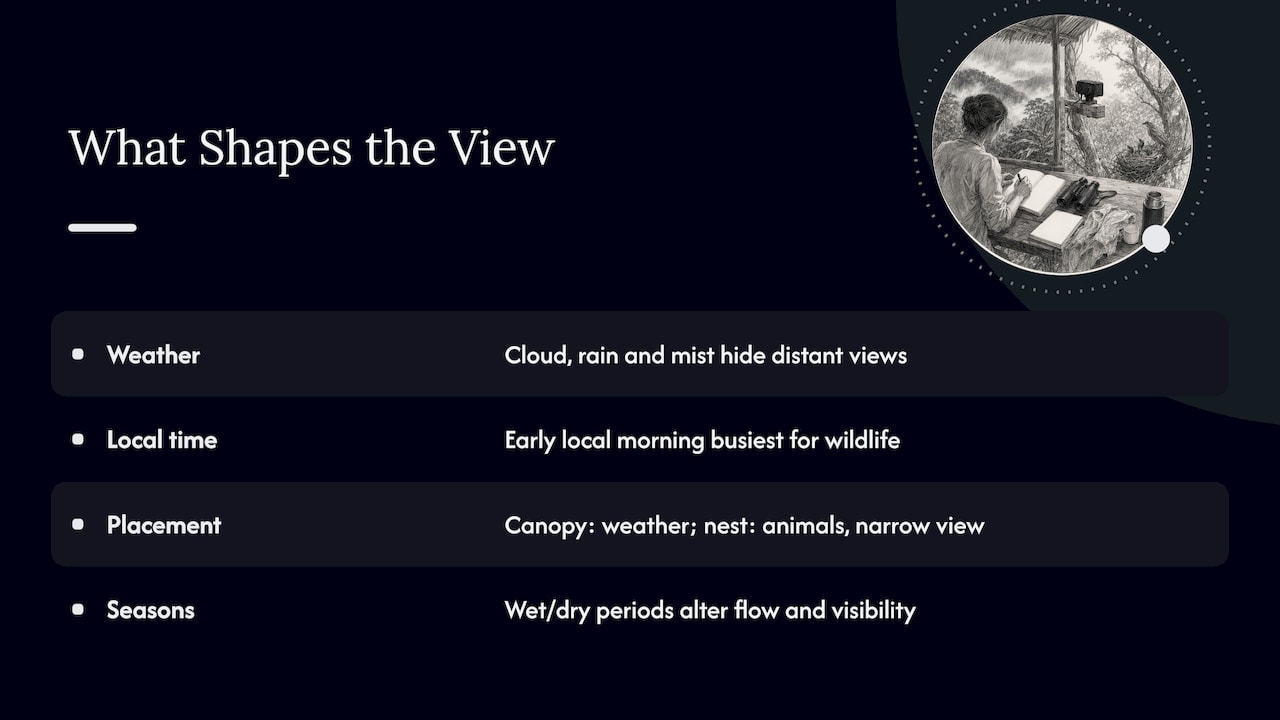
Weather and visibility. Cloud, rain and mist are normal in these forests and often hide the distant view. Land-management webcams in the United States are used specifically to observe haze and air pollution: the Federal Land Managers’ network says its cameras are useful for observing the impacts of air pollution and haze on visibility and air quality. The same principle works for reading a foggy forest cam: low visibility is information about the air, not necessarily a camera fault.
Daylight and time zones. When it is evening in the United States, it may be morning in northern Australia and the middle of the night in other tropical regions. Check local time before you decide a feed is broken. For birds and mammals, early local morning is usually the busiest period, which means many U.S. viewers need an early alarm or a late night.
Camera placement. Canopy cameras show structure and weather. Ground-level and nest cameras show animals but a narrow slice of the world. A camera fixed on a waterfall will not show you the trail to it, the parking situation or whether the viewpoint is open.
Seasons. Tropical rainforests often have wetter and drier periods rather than the four seasons of temperate places. That can change both waterfall flow and how clearly you can see across the forest. Look at the same camera in different months and you will learn its personality quickly.
Using webcams to plan a trip, within limits
A webcam is a good way to preview a destination. You can see whether a lookout tends to sit in cloud, whether a river looks high or whether a forest feels like the place you imagined. It also helps you decide if a place is worth a longer look.
It is not a safety tool. A camera image may be old, partial or pointed away from the hazard. Do not rely on webcam imagery alone for decisions about weather, roads, river crossings, trails or travel. Use the official park service, national weather agency or road authority for current conditions, and check the local operator for closures. That is especially true in rainforest regions, where rain can raise rivers and close tracks within hours.
If you are planning around a US park, our United States webcam pages group cameras by place, and the Redwood National and State Parks webcams show what a temperate coastal rainforest looks like. Redwood country is not tropical, but the fog, tall canopy and damp forest floor make it a useful comparison if you cannot travel to the tropics. For other wildlife viewing, see our guides to zoo webcams and to checking a sea otter stream, which use the same verification habits.
Find rainforest and waterfall views on GlobeWebcams
GlobeWebcams is a worldwide webcam directory that lets you browse public or authorized cameras by location, country and category on a global webcam map. We do not own or operate the cameras. Each page links back to the original provider, and we apply source-rights, availability and quality checks before publishing. You can read how that works on our methodology page and see where feeds come from on our sources page. If you want to look beyond the US, the map also lets you move between countries, such as Canada and Iceland, where waterfalls and dense forest views are common subjects.
A simple way to build your own watch list
If you want a handful of cams to return to, start small and keep notes.
- Pick one canopy or landscape cam for atmosphere and weather.
- Pick one waterfall cam to see how flow changes by season.
- Add one wildlife cam only if you are willing to check its season first.
- Bookmark the operator’s page, not just the stream, so you see notices.
- Note the local time zone next to each one.
After a few weeks you will know when each camera looks its best, and you will stop mistaking a quiet night for a dead feed.
FAQ
Are rainforest webcams live all the time?
No. Some run around the clock, but many are seasonal, go dark at night or drop out when power or connectivity fails. Wildlife nest cams in particular often stream only during a breeding season, as the operator of the MacawCam notes on its own page. Check the operator’s page for the current status.
What can you see on a rainforest webcam?
It depends on the camera. Canopy cams show treetops, cloud and weather. Exhibit cams, such as a museum’s butterfly house, show plants and insects. Wildlife cams may show a nest or feeding spot, and waterfall cams show flowing water. Animals are never guaranteed on camera.
When is the best time to watch a waterfall webcam?
Watch when the flow is strongest, which depends on the source. At Yosemite Falls, the conservancy says peak flow comes in early summer with snowmelt. In tropical forests, wet-season rain usually raises flow, though cloud can hide the view. Look at the camera across several months to learn its pattern.
Can I use a webcam to decide whether it is safe to hike or drive?
No. A webcam image can be delayed, partial or out of date, and it does not show hazards outside its frame. Use the official weather service, park authority or road agency for current conditions, and treat the camera as a supplement.
Sources
- Daintree Rainforest Observatory live cameras, James Cook University
- The Florida Museum’s Butterfly Rainforest exhibit
- Oxley Wild Rivers National Park, NSW National Parks
- Wildlife Webcams, U.S. Fish & Wildlife Service
- MacawCam, Wired Amazon
- Yosemite Falls Webcam, Yosemite Conservancy
- Barron Falls, Skyrail
- Live Webcams, Federal Land Managers
- CFHT Webcams
Recommended
- Find Reliable Live Nature Webcams Worldwide: 5…
- Wildlife Webcams: Check Whether a Feed Is Live…
- Find National Park Webcams Fast: Map Search…
- Live Zoo Webcams in a Couple of Clicks, Find…
Webcam availability and conditions can change without notice. GlobeWebcams does not operate most listed cameras; feeds and imagery remain under the control of their original providers. Do not rely on webcam imagery alone for weather, road, travel or safety decisions.