Cherry Blossom Webcams: Where to Watch Bloom Online

Cherry blossom webcams let you follow a bloom from your desk: the first swollen buds, the few days of peak, and the petals falling afterward. The most useful ones are run by the people who look after the trees, such as park alliances, universities and national park partners. Below you will find where those cameras are, what each view tells you, how to judge whether a feed is current, and why a camera should never be your only source for a trip decision.
GlobeWebcamsFind Cherry Blossom Views OnlineExplore public or authorized webcam views by location through an interactive global map, with perspectives on nature, landmarks and destinations.Explore the webcam mapTL;DR
- The best cherry blossom cams come from the places that manage the trees: the Tidal Basin in Washington, D.C., Branch Brook Park in New Jersey, the University of Washington Quad in Seattle, and sites across Japan.
- Bloom timing shifts every year with weather, so a cam is best used as a monitor in the days before a visit, not as a calendar.
- A feed is only worth trusting if it shows a timestamp, names its operator and matches what the official bloom updates say.
- Check the operator’s own page for the current stream. Embedded or copied views can be stale.
- Use cams alongside official forecasts, weather and park notices, never instead of them.
Table of Contents
- What a cherry blossom webcam actually shows
- Where to find cherry blossom cams in the United States
- Sakura live cams in Japan
- Why bloom timing is hard to predict
- How to tell that a cherry blossom cam is current
- What makes a cherry blossom cam worth watching
- Planning a visit with a webcam as one input
- Find more views on GlobeWebcams
- Etiquette and expectations for bloom-watching online
- A sample plan for one bloom season
- FAQ
- Sources
What a cherry blossom webcam actually shows
A bloom cam is a fixed or slowly rotating camera pointed at flowering trees. Some stream continuously. Others refresh a still image every few minutes. What you get depends on the operator, and that is the first thing to check.
Three kinds of views come up most often:
- Tree-level views. A camera on a campus quad or park path shows individual branches. You can see whether buds are closed, partly open or full, which is the information bloom watchers care about most.
- Landscape views. A rooftop or tower camera shows a whole shoreline or park. It is better for atmosphere and for judging crowds or weather than for counting open flowers.
- Corridor views. Cameras along a road, river or festival route show a line of trees plus the people and vehicles moving past.
In Japan, researchers studying the Kitakami Tenshochi cherry spot found that its cameras let viewers check bloom stages, visitor numbers, parking congestion and weather. That mix is a good model for what to look for: the flowers matter, but so does what the scene around them tells you.
Where to find cherry blossom cams in the United States
Washington, D.C.: the Tidal Basin BloomCam
The best-known US cherry blossom camera overlooks the Tidal Basin. The Trust for the National Mall, working with the National Park Service and EarthCam, provides a 24/7 live BloomCam over the cherry trees. The festival describes it as a real-time view that also gives you the trees across the seasons, not only in March and April.
The camera has moved before. The National Park Service’s cam page says it was up and running in a new location and credits the Trust and EarthCam. The Trust’s 2026 release said that year’s #BloomCam streamed from the top of the Salamander Hotel DC. Because the vantage point can change from one season to the next, start from the festival or park service page rather than from an old bookmark.
The Tidal Basin trees are Yoshino cherries, and the park service defines peak bloom as the point when 70% of the Yoshino blossoms are open. That definition is useful when you watch the cam. If you see a scattering of open flowers among many closed buds, you are not yet at peak.
New Jersey: Branch Brook Park
Branch Brook Park in Newark is known for one of the largest collections of cherry trees in the country. VisitNJ notes that the Branch Brook Park Alliance maintains a live camera of its cherry trees so the public can monitor bloom progression. For a local day trip, that is exactly the right use: look the morning you plan to go, and again the day before.
Seattle: the University of Washington Quad
The University of Washington’s Quad is a popular spring stop, and the university publishes a cherry blossom cam on its campus webcam pages. In a March 2026 update, UW explained that temperature swings had slowed bud development, that cool weather could delay peak bloom and that warm weather could cause a sudden transition. It advised readers to check the live cams for updates. UW researchers are also building a model that uses weather data to predict peak bloom on campus.
California and elsewhere
Cherry trees in warmer regions bloom on a different schedule from those on the East Coast. If you are planning around Southern California, this guide to checking the San Diego garden’s bloom before you go is a practical companion to any camera view.
You can also browse everything we list for the country on our United States webcams page, where cameras are organized by place and category.
Sakura live cams in Japan
Many readers searching for a sakura live cam want Japan, where cherry blossom viewing (hanami) is a national spring ritual. Cameras there tend to be run by city tourism offices, local festival committees or river and road authorities. Examples that regularly come up in searches include the Kawazu cherry trees on the Izu Peninsula and the Miura Kaigan festival route in Kanagawa. Whether a particular stream is running right now is something only the operator’s own page can tell you.
Timing is the main thing to understand. The bloom does not arrive everywhere at once. It moves north as a front. For 2026, the Japan Meteorological Corporation forecast the first blossoms around March 20 in Tokyo and around April 25 in Sapporo, more than five weeks apart. That forecast was specific to 2026 and based on that year’s weather, but the pattern of a south-to-north progression holds from year to year.
That is why a Japan cam is useful in two ways. You can watch the local bloom, and you can compare feeds from different latitudes to see how far the front has traveled.
Why bloom timing is hard to predict
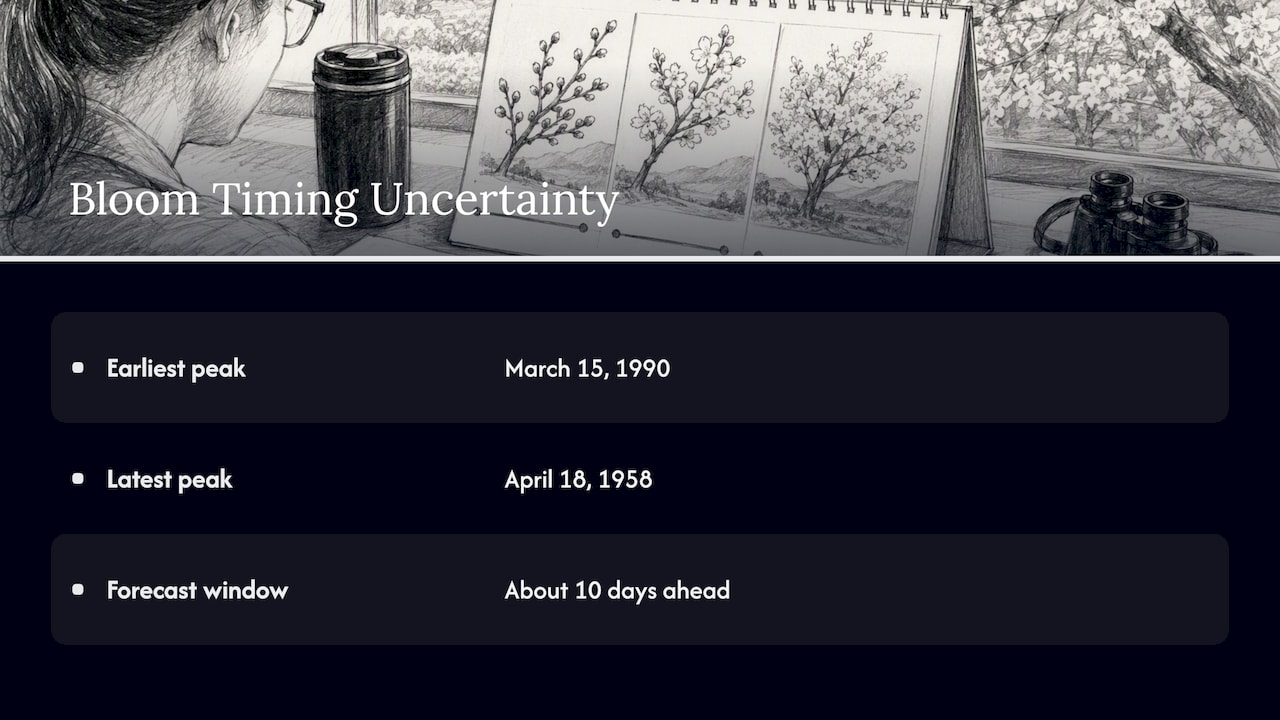
If you are planning a trip around a bloom, understand how much the dates move. National Park Service records show that Washington’s peak bloom has fallen as early as March 15 (in 1990) and as late as April 18 (in 1958). The same page notes how hard it is to predict the window more than about 10 days ahead.
Weather decides the rest. The park service explains that cool, calm conditions can stretch out the bloom of several days, while rain or wind can end it abruptly and a late frost can prevent it altogether. That is the practical value of a webcam: it shows what the trees are doing now, not what an average year would do.
Research from Japan adds a useful detail. A study of Yoshino cherry flowering in Okayama found that bloom was earliest in the central commercial area, followed by the north and then the south residential areas. The study also reported that globe temperature, which reflects solar radiation, infrared radiation and wind as well as air temperature, can predict flowering dates better than air temperature alone. For a viewer, the lesson is that a camera in a sheltered, built-up spot may show flowers sooner than one in an open park a few miles away.
Reading a camera against the calendar
A quick routine helps:
- Look at the official bloom update for the place, if one exists.
- Open the camera and compare what you see to the stage the update describes.
- Check the local weather forecast for wind and rain, which can strip petals quickly.
- Look again on the morning you travel.
How to tell that a cherry blossom cam is current
The most common problem is not a dead camera but an old one. A still image from last week or a recorded video that is labeled live can mislead you at exactly the moment you need accuracy. A 2024 study of bloom monitoring noted that low picture quality, slow connections and camera shake made visual inspection hard, and that many YouTube videos did not show the date they were taken.
Use this checklist before you trust a view:
- A visible timestamp. The image should show a date and time, or the page should say when it last updated.
- An identifiable operator. A park alliance, university, tourism board or named camera company gives you someone accountable. An unnamed embed does not.
- Consistent light and weather. If the sky is bright at what should be night in that time zone, or the weather does not match the local report, something is off.
- Motion or refresh. Watch for a minute. A live stream shows movement, such as people, cars or branches. A still image should change at its stated refresh interval.
- The operator’s page. Load the stream from the source rather than a copy.
Some operators also say plainly what happens when a feed drops. One wildlife organization notes that its cameras switch to a highlights reel at night and when the signal to a remote site is lost, for example after a power outage or technical problem. Cherry blossom cams can behave the same way, so a replay is not proof of a working camera. We cover the same habits for animal feeds in our guide to checking whether a wildlife webcam is live.
What makes a cherry blossom cam worth watching
Not every camera pointed at a tree is a good one. These are the qualities that separate a useful view from a pretty but unhelpful one:
| Quality | What to look for | Why it matters |
|---|---|---|
| Framing | Trees fill a good part of the frame, not a distant skyline | You can judge bud and flower stage |
| Resolution | Branches and individual flowers are distinguishable | Low quality hides the difference between buds and blossoms |
| Update rate | Continuous stream or frequent refresh with a timestamp | A stale image can look current |
| Context | Sky, ground and people visible | Shows weather, petal fall and crowds |
| Operator | A named park, school or tourism body | Someone responsible for the feed |
| Season coverage | Stays online beyond bloom | Lets you compare the trees across months |
The last point is easy to overlook. The D.C. BloomCam is described as giving year-round views of the trees, so you can see the bare branches, the buds, the peak and the fall. Watching a full cycle teaches you what “almost there” looks like, which makes future planning easier.
Planning a visit with a webcam as one input
A camera answers one question: what do the trees look like at this moment? It does not tell you whether the roads are clear, whether paths are open, how crowded the park will be tomorrow or whether tonight’s storm will end the bloom. Treat it as one input among several.
For a trip, combine:
- the official bloom or festival page for the location,
- the National Weather Service or local forecast for the dates you will be there,
- park or transit notices for closures and road conditions,
- and the webcam, for the most recent look at the trees.
Do not rely on imagery alone for weather, road, travel or safety decisions. A camera can be pointed away from the problem, delayed or offline.
If you want to build a broader plan around national parks and scenic stops, our guide to finding national park webcams fast explains how to use map search to compare nearby views.
Find more views on GlobeWebcams
GlobeWebcams is a discovery directory for public and authorized webcams, organized by country, category and location. We do not own or operate the cameras. Each page links back to the original provider so you can open the stream at its source, and we apply rights, availability and quality checks before publishing a page. You can read how that works on our methodology page and see where views come from on our sources page.
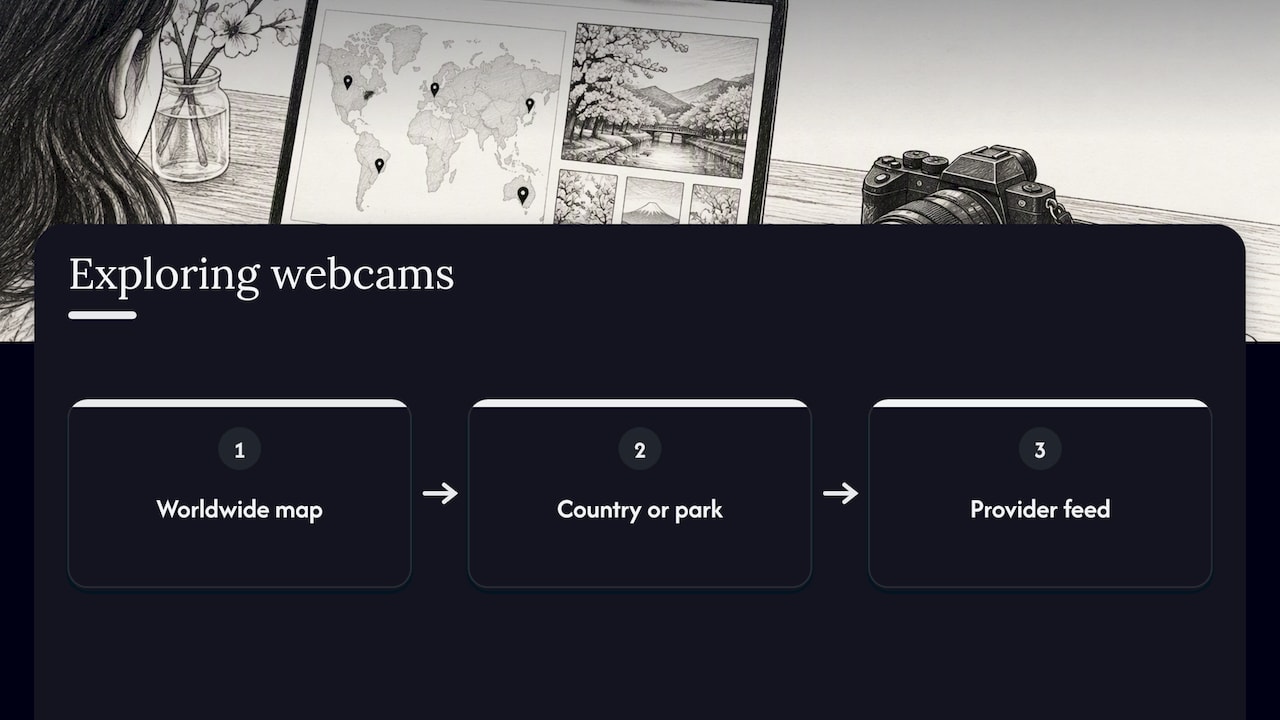
To explore, start with the worldwide webcam map, zoom to a country or park, and open the provider’s feed. If you are traveling in Canada, our Canada webcams page is a good starting point. For general scenery in the US, try the Redwood National and State Parks webcams or the Boston Harbor Islands webcams for coastal conditions.
A caution on what we show: a listing on our site is a pointer to a provider, and we do not claim that any camera is live or working at a given moment. Always confirm on the provider’s page.
Etiquette and expectations for bloom-watching online
A few habits make the experience better and keep expectations realistic.
Expect gaps. Cameras go offline for maintenance, power loss or relocation. If a feed is dark, check the operator’s social media or website for a notice.
Do not expect a perfect view. Rain on the lens, fog, glare and wind movement are normal. A blurry morning image often clears later in the day.
Respect the source. Many bloom cams are provided free by park partners and universities. Link to them, credit them and avoid downloading and reposting their streams as your own.
Watch over several days. One look gives you a snapshot. A look each morning for a week shows the trend, which is far more informative than a single frame.
Compare more than one place. If a friend lives near another cherry spot, or you can open a second camera, comparing them shows how local conditions shape the bloom, as the Okayama research on different parts of one city suggests.
A sample plan for one bloom season
Here is how a bloom-watcher might use cameras without leaning on them too hard. Adjust the timing for your own region, since bloom dates differ widely.
- A few weeks out. Open the official bloom page for your destination and note what the operator says about expected timing. Remember that forecasts more than about 10 days out are uncertain, as the park service’s records show.
- Ten days out. Start checking the camera once a day. Note whether buds are tight, swelling or beginning to open.
- Three days out. Compare the camera view with the forecast. Cool, calm weather can extend peak. Rain or wind can end it quickly.
- The morning of your visit. Check the camera, the weather and any park notices. Decide whether to go, wait or choose a different site.
- After the visit. If the cam is year-round, return in summer or winter to see the same view in another season.
This routine takes a few minutes a day and gives you a much better picture than any single article or social post.
FAQ
Is there a live cherry blossom cam for Washington, D.C.?
Yes. The Trust for the National Mall, with the National Park Service and EarthCam, provides the BloomCam over the Tidal Basin, and the festival describes it as a 24/7 view. The camera location has changed in the past, so open it from the festival or park service page and check the timestamp.
When is the best time to watch a sakura live cam?
It depends on the place and the year. Washington’s peak bloom has ranged from mid-March to mid-April in the park service records, and Japan’s bloom moves from south to north over several weeks. Watch your chosen cam daily in the weeks before the expected window.
How do I know a cherry blossom webcam is really live?
Look for a visible date and time, an identifiable operator and signs of change, such as moving people or shifting light. Load the stream from the operator’s page and compare the view with the local weather. A replay or highlights reel can look like a live feed.
Can I use a webcam to decide whether to travel for the bloom?
Use it as one input. Pair it with the official bloom update, the local forecast and park or road notices. Rain, wind or frost can end the bloom within days, so check again the morning you leave.
Sources
- Bloom Watch, National Park Service
- Cherry Blossom Peak Bloom Watch, National Cherry Blossom Festival
- Cherry Blossom Cam, National Park Service
- #BloomCam release, Trust for the National Mall
- Stunning Cherry Blossoms in New Jersey, VisitNJ
- Peak bloom predictions for UW’s cherry trees, University of Washington
- Predicting cherry tree bloom timing at the UW, University of Washington
- The phenology of cherry blossom in Okayama, International Journal of Biometeorology
- Retrieval of cherry flowering phenology, Frontiers in Sustainable Tourism
- Live Streams, OrcaLab
Recommended
- Rainforest Webcams: Where to Watch and How to
- Find Reliable Live Nature Webcams Worldwide: 5 Tips
- Find National Park Webcams Fast: Map Search
- Live Zoo Webcams in a Couple of Clicks, Find
Webcam availability and conditions can change without notice. GlobeWebcams does not operate most listed cameras; feeds and imagery remain under the control of their original providers. Do not rely on webcam imagery alone for weather, road, travel or safety decisions.