Cathedral Webcams: Where to Watch and How to Check

Most cathedral webcams fall into two groups. The first group is wildlife cameras: peregrine falcon nest cams on spires and towers, which usually run in spring and summer. The second is view cameras, which show a facade, a cloister or a nave, or stream a chapel for prayer. Peregrine cams are the most common, and several English cathedrals run them. Year-round streams exist too, such as the one at Reims in France. Below you will find which cathedrals stream, what each camera shows, when they tend to be active, and how to confirm a feed is running before you plan around it.
GlobeWebcamsExplore Cathedral Views and MoreBrowse webcams by location, country, category or source, and use the interactive map to discover live views from destinations around the world.Explore webcams on the interactive mapTL;DR
- Peregrine nest cams at English cathedrals such as Chichester, Lincoln, Norwich, Salisbury, St Albans and Worcester are seasonal. The Association of English Cathedrals keeps a status list for the nesting season.
- Some cathedral cameras run all year, for example Reims Cathedral’s webcam, which streams around the clock.
- Always open the cathedral’s own page or the original provider to see whether a stream is live, not yet switched on or off for the year.
- For botanical garden cams, Lewis Ginter in Richmond, Virginia is a documented example with a garden livestream.
- Treat any webcam as a view, not as a source for weather, travel or safety decisions.
Table of Contents
- Why cathedral webcams are mostly about falcons
- Cathedrals with peregrine webcams
- When cathedral webcams are usually active
- How to check that a cathedral webcam is live
- Planning a visit around a cathedral cam
- Botanical garden webcams
- Where GlobeWebcams fits in
- A short viewing checklist
- FAQ
- Sources
Why cathedral webcams are mostly about falcons
Cathedrals are tall, stone, and stable, which is close to the cliff edge that peregrines evolved to use. A spire or bell tower gives the birds a high perch and a nesting ledge. A conservation officer from the Hawk and Owl Trust noted in 2013 that peregrines are traditionally sea cliff nesters used to harsh weather. At Norwich, the nesting platform was placed so the spire deflects most north and northeasterly winds, according to a 2013 Hawk and Owl Trust press release.
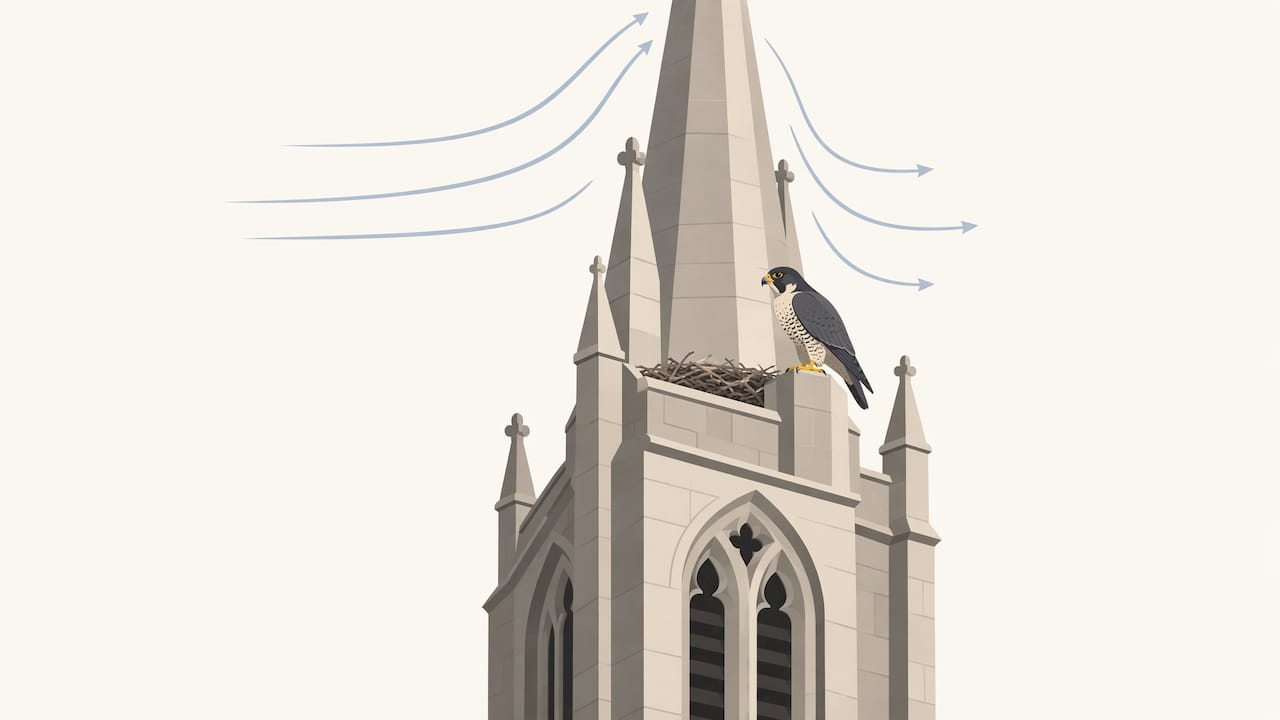
That is why the search results for this topic are dominated by cathedral peregrine pages. Cathedrals and wildlife charities place cameras close to the nest, then stream the footage to the public.
The cameras also do real work. The Herts and Middlesex Wildlife Trust says its St Albans webcam helps monitor the breeding success of the falcons, and that if the birds succeed the Trust will look to ring the chicks. Ringing can provide information on survival rates and movements.
For a wider look at nest cameras of this type, see our guide to peregrine falcon cams and their seasonal status.
Cathedrals with peregrine webcams
The Association of English Cathedrals published a list of peregrine webcams, updated on 21 April 2026. It covers Chichester, Derby, Ely, Leicester, Lincoln, Norwich, Salisbury, St Albans, Wakefield, Winchester and Worcester. The list marks each camera as live, not yet live, or to be checked again when nesting begins. It also notes that Norwich’s stream comes courtesy of the Hawk and Owl Trust.
Here is what the research tells us about the better-documented ones.
| Cathedral | What the camera shows | Who is involved | Pattern |
|---|---|---|---|
| Chichester | Peregrines in the cathedral’s south east turret | The cathedral | Cameras have run for more than two decades |
| Lincoln | Peregrines nesting in the central Bell Tower | Cathedral, University of Lincoln, Quickline | Two cameras, one looking east over a “larder shelf” |
| Norwich | Peregrines on the spire’s nesting box | Hawk and Owl Trust | Spring nesting season |
| Salisbury | Live nestbox webcam | Cathedral with the RSPB South Wiltshire Local Group | Switched off after the season, back in early the next year |
| St Albans | Peregrine nest tray | Herts and Middlesex Wildlife Trust | Switched on in mid-March for 2026 |
Chichester
Chichester says that its peregrine cameras have been live for more than two decades. It marks 2026 as the 25th anniversary of peregrines first being regularly observed there, with more than 70 to 80 chicks fledged since the early 2000s. The cathedral also hosts Peregrine Open Days on Cathedral Green. In 2026 these ran Wednesday to Sunday from 6 June to 5 July. Check the cathedral’s page for the current year’s arrangements.
The Association of English Cathedrals describes Chichester as the first cathedral in Europe to use webcam technology for peregrines. Since 2001 a pair has raised chicks in the south east turret.
Lincoln
Lincoln’s peregrines have nested in the central Bell Tower for more than a decade. According to the same Association article, they had raised at least 27 young at the time of writing. A collaboration between the cathedral, the University of Lincoln and the internet provider Quickline made the live feed possible. The cathedral says it has two peregrine cams outside the bell chamber, one looking east over what it calls the larder shelf.
Norwich
Norwich Cathedral’s spire is home to resident peregrines. The Hawk and Owl Trust runs a live stream from the nesting box and the page carries the latest peregrine news. In 2013 the Trust reported that over a million people had watched the family through the webcam or through telescopes at the Peregrine Watch Point in the cathedral grounds (the press release gives the detail).
Salisbury
Salisbury’s cathedral runs a live peregrine nestbox webcam in partnership with the RSPB South Wiltshire Local Group, which helps share and analyse the footage. After the 2026 nesting season the cameras were switched off for the rest of the year, to be reactivated in early 2027. That is the normal rhythm for these feeds: off in autumn and winter, back before the next season.
St Albans
The Herts and Middlesex Wildlife Trust switched on the St Albans nest tray camera in March 2026. The pair were breeding for the fifth successive year, and the first chick hatched in 2022. The camera is sponsored by Opticron. The Trust’s season wrap-up says the female laid four eggs, a record for the pair. The first hatched in the early hours of 9 May, and all three chicks that survived fledged. The webcam was then switched off after attracting over half a million page views.
That last detail matters for planning. A cam that was thrilling in May can be dark by August because its job is finished.
When cathedral webcams are usually active
Falcon cams follow the nest
The St Albans timeline gives a good picture. The camera went on in mid-March once the female began making a scrape, which is the shallow nest hollow where eggs are laid. Eggs were laid in the following weeks, hatching came in May, and fledging followed. When the chicks left, the camera went off.
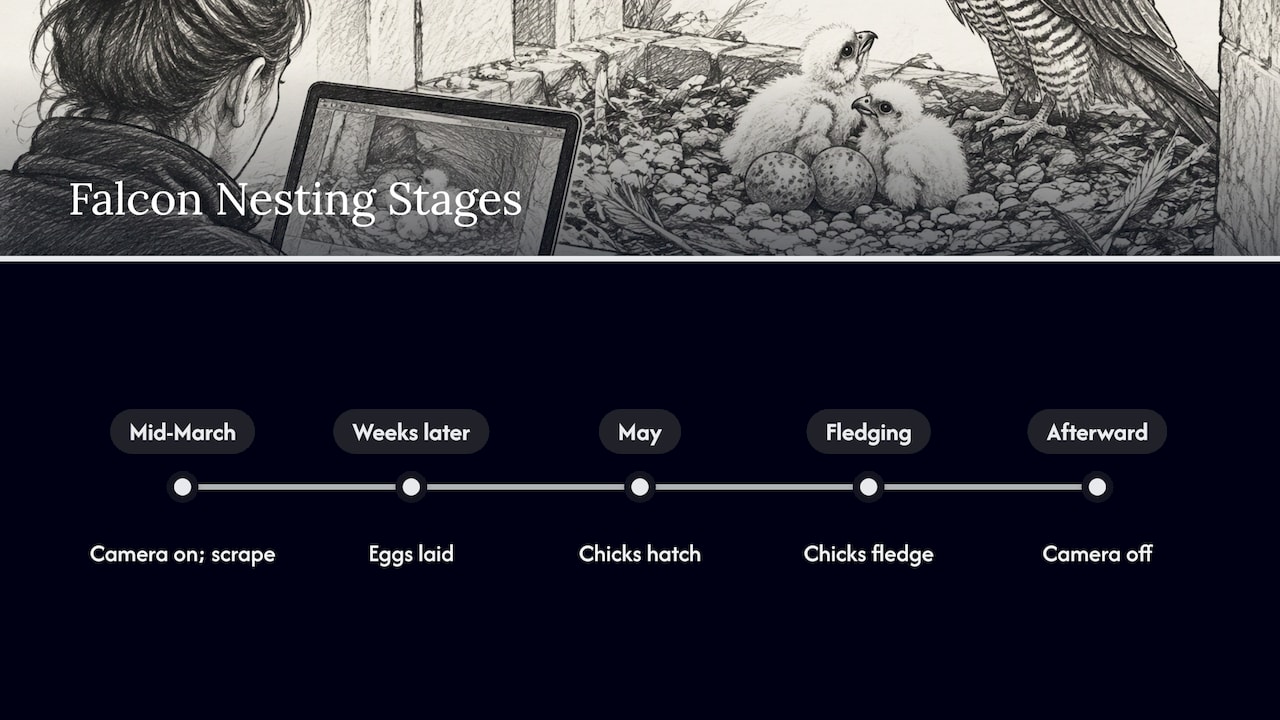
Cathedral pages describe the same window in their own words. One cathedral notes that peregrines can be seen from its gardens and grounds from April to August, both adults and later the juveniles.
So a sensible rule is to look in spring for eggs and early chicks, and in early summer for growing chicks. After that, expect many cameras to be switched off until the next breeding season. The exact dates change from year to year and from nest to nest, so the cathedral or trust page is the right place to check.
View cams can run longer
Not every cathedral camera is about wildlife. Reims Tourisme’s Notre-Dame de Reims webcam streams automatically in real time, 24 hours a day, all year round. That makes it useful for seeing the building across different times of day and seasons.
In England, Clifton Cathedral in Bristol streams a different kind of view. Its page says Mass is streamed from the cathedral daily, and the Blessed Sacrament Chapel is live-streamed around the clock to aid private devotion and prayer. The cathedral says the stream is sometimes muted for privacy or copyright reasons. If you open a worship stream, remember it is a place of prayer first and a camera second.
Older cathedral cameras show how limited some feeds can be. An archived 2008 page for Peterborough Cathedral described three cameras: the West Front and Cathedral Court, the cloister, and an interior view looking east down the nave. Pictures refreshed roughly every 60 seconds between 05:00 and 23:00 local time, and in darkness, especially in winter, the picture might be unavailable while the cathedral was closed. That is a 2008 snapshot, not today’s setup, but it explains why a dark or frozen image is not always a fault.
How to check that a cathedral webcam is live
A webcam page can look fine and still show an old image. Use this routine.
- Start at the provider. Open the cathedral’s own page or the wildlife trust running the camera. They know whether the season has begun.
- Check the season list. For English peregrine cams, the Association of English Cathedrals’ list marks each camera as live, not yet live or to be checked again when nesting starts. Note its update date.
- Look for a moving clock or motion. Clouds, birds, passing traffic, a flag or a changing time stamp show the picture is moving. A frozen frame is a warning.
- Think about local time. A dark image at night is normal. Many cathedrals are closed after dark, and interior cameras may show nothing without lights.
- Read the notice text. Providers often post “switched off for the season” or “returns in early next year” messages. Salisbury’s page is a clear example of this.
- Reload and try another device. A stalled player is common. A reload tells you whether the stream itself is stuck.
For general habits that apply to any nest or wildlife camera, our guide on how to check whether a wildlife webcam is live covers the same ground in more depth.
A note on decisions: a webcam shows one view at one moment. Do not use it as your only guide for weather, road or travel decisions. Use official forecasts and local authorities for those.
Planning a visit around a cathedral cam
Webcams work well as a preview. You can see the angle of the building, the light at different hours and how busy the surroundings look, though a camera never gives the full picture.
Some cathedrals pair cameras with in-person viewing. Chichester’s open days on Cathedral Green and Norwich’s Peregrine Watch Point are examples, with telescopes aimed at the nest. Dates and hours vary by year, so use the cathedral’s page for the current schedule. If you plan a spring trip, a camera in March or April can tell you whether the birds are settled on the nest.
For architecture rather than wildlife, think of cathedral cams as a kind of city landmark view. Our guide to finding and judging city landmark webcams shows what to look for in angle, resolution and source. If the cathedral is part of a skyline, the guide to verifying city skyline webcams helps you confirm what you are looking at.
Botanical garden webcams
Some readers who search for cathedral cams also look for botanical garden cams, since both offer calm, scenic views. The research behind this guide documents one clear example in the United States.
Lewis Ginter Botanical Garden in Richmond, Virginia offers a garden livestream that you can watch any time of day from anywhere. The garden’s daytime admission hours are 9 a.m. to 5 p.m., and the page invites viewers to bookmark it for a dose of nature when they cannot visit. Garden cams are a good way to see seasonal change: bare beds in winter, bulbs in spring, full borders in summer.
The same checks apply as for cathedral cams. Go to the garden’s own page, look for movement, and remember that dark hours and winter weather affect what you see. Because garden cams depend on each garden’s setup, we do not claim any camera is live at a given moment. Open the provider’s page to confirm.
Where GlobeWebcams fits in
We do not own or operate any of these cameras. GlobeWebcams is a discovery platform: we help you find public or authorized webcams by location, country and category, and we link back to the original providers. We apply source-rights, availability and quality checks before publishing a webcam page, and we are conservative about it.
If you want to browse beyond cathedrals, start with the worldwide webcam map or the public webcam directory. For related seasonal viewing, our guides to puffin cams and owl nest webcams show how to verify the stage of a nesting season.
A short viewing checklist
- Search by the cathedral’s name plus “peregrine” or “webcam” and open the cathedral’s own site.
- In spring, expect eggs and chicks. After summer, expect many nest cams to be off.
- Note who runs the camera: the cathedral, a wildlife trust, a university or a tourism office.
- Respect worship streams. Do not capture or share images of people without permission.
- Pair any camera with official sources if you are making a trip decision.
FAQ
Which cathedrals have live webcams?
Many English cathedrals stream peregrine nests, including Chichester, Derby, Ely, Leicester, Lincoln, Norwich, Salisbury, St Albans, Wakefield, Winchester and Worcester, per the Association of English Cathedrals’ list. Reims Cathedral in France has a view webcam, and Clifton Cathedral streams a chapel. Check each provider’s page for current status.
Are cathedral webcams on all year?
Not usually for peregrine cams. They tend to run through the nesting season, then switch off. Salisbury, for example, switched its cameras off after the 2026 season and planned to reactivate them in early 2027. Some view cameras, such as the one at Reims, stream continuously.
When is the best time to watch a peregrine cam?
Spring is the main time. St Albans switched its camera on in mid-March 2026, saw hatching in May and switched it off after the chicks fledged. Timing differs by site and year, so check the cathedral or trust page.
How can I tell if a webcam is really live?
Open the provider’s page and look for motion, a changing time stamp or a status notice. A frozen frame, an old date or a season-off message means it is not live. If you need weather or travel information, use official sources instead of the picture.
Is there a botanical garden webcam I can watch?
Lewis Ginter Botanical Garden in Richmond, Virginia provides a garden livestream on its own site. Open it to see whether it is running at the moment you visit.
Sources
- Updated: Cathedral Peregrine Webcams, Association of English Cathedrals
- Up Close and Personal with our Cathedral Peregrines, Association of English Cathedrals
- The Chichester Peregrines, Chichester Cathedral
- Peregrine Falcons, Norwich Cathedral
- Norwich peregrines 2013, Hawk and Owl Trust press release
- Live Peregrine Nestbox Webcam, Salisbury Cathedral
- Live Action as Peregrine Falcons at St Albans Cathedral, Herts and Middlesex Wildlife Trust
- 13: A Truly Lucky Number, Herts and Middlesex Wildlife Trust
- Webcam LIVE Reims cathedral, Reims Tourisme
- Welcome to Clifton Cathedral, stream page
- Peterborough Cathedral Now, archived 2008
- Lewis Ginter Garden Cam, Lewis Ginter Botanical Garden
Recommended
- Bridge Webcams Live: How to Find and Use Them
- City Landmark Webcams: How to Find and Judge Them
- How to Verify Travel and Nature Webcams
- Town Square Webcams: What You Can See and How
Webcam availability and conditions can change without notice. GlobeWebcams does not operate most listed cameras; feeds and imagery remain under the control of their original providers. Do not rely on webcam imagery alone for weather, road, travel or safety decisions.