Fall Foliage Webcams: How to Follow Autumn Color Live
Fall foliage webcams let you watch leaves change from a screen, from a mountain overlook, a town square or a national park viewpoint. They work best as one input among several. A camera shows what one spot looks like when its image was captured, so you read it for color progress, then check weather, local reports and park guidance before you drive anywhere. This guide explains what these cameras can and cannot tell you, how to pick a useful one, and how to turn what you see into a plan.
GlobeWebcamsExplore Autumn Views LiveBrowse public or authorized webcams by location, country and category to explore autumn landscapes and destination views on an interactive map.Explore webcams on the mapTL;DR
- Foliage webcams show the color stage at one fixed viewpoint. They do not tell you what a whole region looks like.
- Check the timestamp, the image’s lighting and the source before you trust any view as current.
- Timing shifts every year with temperature, sunlight, rainfall and soil moisture, so last year’s peak dates are only a rough guide.
- The National Park Service notes that many national-park webcams showcase fall color changes, and it asks visitors to plan ahead and follow safety guidance.
- Never decide on a drive, a hike or road conditions from webcam imagery alone.
Table of Contents
- What fall foliage webcams actually show
- Where to find fall foliage cameras
- How to choose a useful foliage webcam
- Why foliage timing changes every year
- Webcams, foliage maps and local reports: what each does best
- Turning a webcam view into a fall outing plan
- Beyond the leaves: other views worth watching in autumn
- Explore autumn views on GlobeWebcams
- Common mistakes when following foliage cams
- FAQ
- Sources
What fall foliage webcams actually show
A foliage webcam is a camera fixed on a view: a ridgeline, a lake shore, a village main street, a valley floor. Over days and weeks the same frame fills with yellow, orange and red, then thins out as leaves drop. That fixed frame is the main strength. You are not comparing one photo to a different photo from another angle. You are watching one place change.
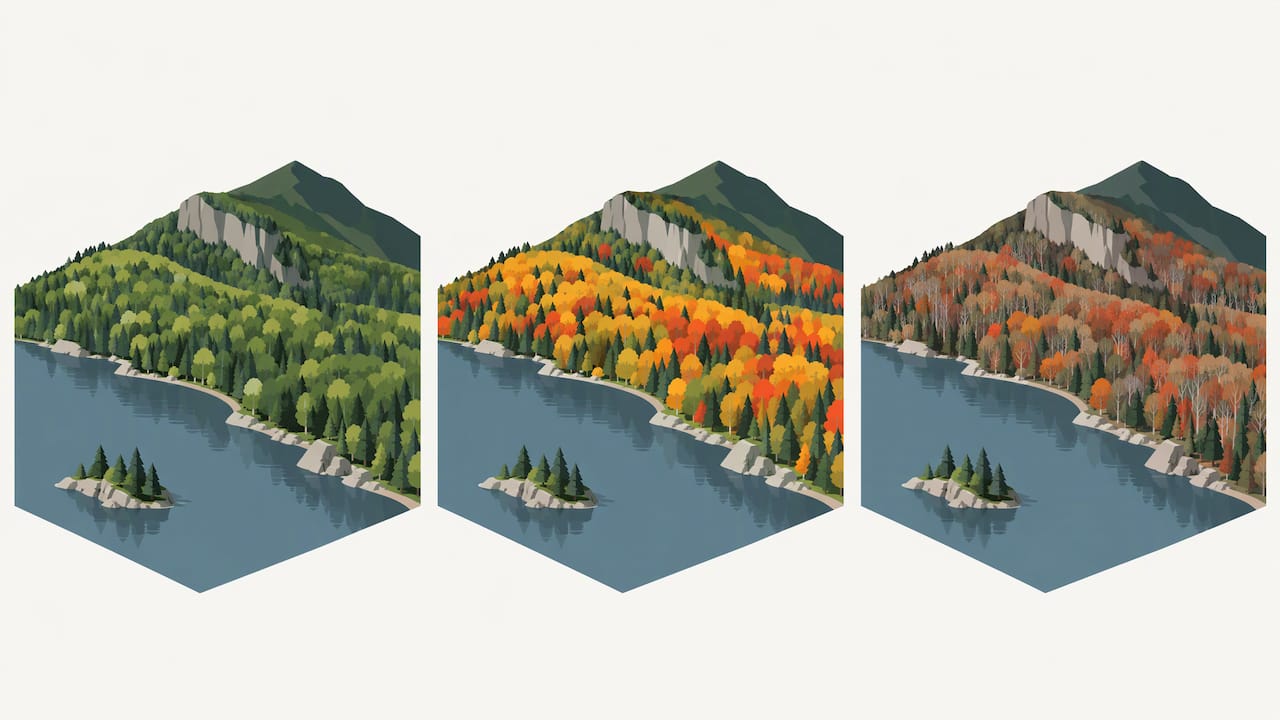
The U.S. National Park Service says that forests, woods, shrublands and grasslands turn a range of colors from roughly September through December each year, depending on climate and conditions. The same page notes that many national-park webcams showcase these changes. That is a useful reminder that the season is not a single weekend in October. In some places color arrives early and in others it lingers well into late autumn.
What a camera can show you:
- Stage of change. Mostly green, patchy, near full color or past peak and bare.
- Weather in the frame. Fog, rain, low cloud or clear light, which affects how vivid the color looks.
- Local character. Hardwood hillsides, lakeside views, historic downtowns or mountain basins.
What it cannot show you: conditions a mile away, road surfaces, trail footing, crowds at a pullout or whether the best color is on the next slope. Treat each view as a single data point.
Where to find fall foliage cameras
Three kinds of sources tend to carry autumn views.
National parks and public lands
Park webcams point at overlooks, valleys and visitor areas that stay in the same position year after year. On GlobeWebcams, the U.S. National Park Service webcams source page lists cameras published by the park service, and our guide on finding national park webcams fast with a map search shows how to narrow them down by park. You can also browse individual pages such as Mount Rainier’s Longmire and Paradise views, where higher elevations and mixed forests give a different kind of autumn scene than a hardwood hillside.
Mountain and scenic-area cameras
Resorts, visitor bureaus and local organizations often run cameras on ridges and valleys. These can be useful in autumn because elevation changes timing: higher ground often changes before lower ground. Our guide to mountain webcams for trips explains how to find feeds and check what you are looking at before you plan around it.
Town and community cameras
Small-town cameras on main streets, courthouse squares and lakefronts show color in a built setting, with trees along streets and on nearby hills. They are good for a quick sense of how the leaves look where visitors actually walk, but their field of view is narrow.
To see all of these in one place, start from the United States webcam directory and open the pages for the states or parks you care about. GlobeWebcams links back to the original providers and applies source-rights, availability and quality checks before publishing a webcam page. We do not own or operate the cameras themselves.
How to choose a useful foliage webcam
Not every camera is good at showing autumn. Run through these checks before you rely on one.
1. Is the image current?
Look for a visible timestamp, a changing sky or moving clouds, or a provider page that states when the image last updated. A still frame with no time information may be old. Some providers publish replays or recorded highlights next to a live view, so check the label on the player. A replay is a recording, and it tells you how the color looked at an earlier time.
How often a camera updates varies. As one example, the academic PhenoCam Network says its digital cameras upload images to its server every half hour. A camera that refreshes every few minutes and one that refreshes every half hour are both legitimate, but they answer different questions.
2. Does the frame include the trees you care about?
A camera aimed mostly at sky, water or buildings tells you little about foliage. Pick views where hillsides, tree lines or a recognizable stand of trees fill a good part of the picture.
3. What is the elevation and exposure?
A summit camera and a valley camera in the same county may be a week or more apart. If you are comparing two views, note the elevation of each, and whether the frame faces a slope that gets morning or afternoon sun.
4. Is the source clear?
A useful camera page tells you who runs the camera. That matters for knowing how it is maintained and where to find official conditions. On GlobeWebcams, each page points back to the original provider so you can go to the source.
5. How is the light?
A bright, low-angle morning can make color look richer than an overcast afternoon. Overcast light can flatten reds and oranges, while direct sun can wash out shadows. Cameras also apply automatic exposure and white balance, and every screen renders color a little differently. If you are curious how photographers think about color in landscape images, this overview of landscape photo color grading techniques shows why the same scene can look different after processing. For a webcam, the practical lesson is to compare a view with itself over several days rather than judging color from a single frame.
Why foliage timing changes every year
A camera shows where a place is right now. Understanding why timing shifts helps you read what you see and guess what is coming.
The Minnesota Department of Natural Resources says weather is the most critical factor in determining the colors displayed each fall. Its guidance is that colors are best when high-quality foliage from a warm, moist summer meets sunny, cool fall days. It also notes that light frosts may help, but hard freezes can ruin the display, and that small swings in September weather (too warm, too cold, too wet or too dry) can slow color change or cause trees to drop leaves before they turn.
NOAA makes a similar point: temperature, sunlight, precipitation and soil moisture influence when fall color arrives, how long it lasts and how vibrant it is. One example it gives is drought in late summer or early fall triggering an early shutdown, which makes leaves fall early without full color.
For a webcam watcher, this means:
- A stretch of green in early October does not mean the season is a bust. Check again in a few days.
- A sudden bare-branch look after a hard freeze or storm may mean the show ended early in that spot.
- Past peak dates are a rough guide, not a schedule.
Looking at a camera over time, and not just once, is the best way to see which way the season is moving.
Webcams, foliage maps and local reports: what each does best
People tracking autumn color usually combine three tools. Each has strengths and blind spots.
| Tool | Best for | Limits |
|---|---|---|
| Live webcam | Seeing the actual color stage and weather at one fixed spot | Narrow view; image may be delayed, replayed or poorly lit |
| Foliage map or forecast | Comparing regions at a glance and seeing the broad trend | Based on models, reports or estimates, not necessarily your exact destination |
| Local report (park staff, visitor centers, local tourism offices) | Road conditions, trail status, closures and where color is strongest | Written by a person at a point in time, so it can lag |
The PhenoCam Network explains why fixed cameras are valuable to scientists. It says near-surface remote sensing is continuous in time, free of clouds and avoids atmospheric-correction issues compared with satellite remote sensing. You are doing something informal but similar when you watch a camera over several days: a repeated view from the same spot gives you a steady signal that is hard to get from a one-off photo.
A good routine is to use a map for the big picture, a webcam for the specific view and a local source for what you need to know before you go.
Turning a webcam view into a fall outing plan
A camera helps you decide when to start looking harder. It should not be the only basis for a trip.
- Pick a region and a rough window. Use the seasonal range for your area and the past few weeks of weather.
- Watch two or three cameras at different elevations. If higher cameras are already past peak, lower ones may be close behind.
- Check weather separately. Look at the official forecast for the area, not just the sky in the camera frame.
- Check road and trail status with the managing agency. Webcam images are not a substitute for road, closure or safety information.
- Have a backup. If one slope is past its best, a nearby park or lake may be better.
The National Park Service tells visitors to plan ahead when viewing fall colors and to follow basic safety guidance: watch your step, keep your distance from drop-offs, wait your turn in crowded areas, keep your eyes on the road and be alert for wildlife. The road one is worth underlining. Scenic drives attract slow traffic and stopped cars in autumn, and the person behind the wheel should watch the road rather than the leaves.
If you are planning around elevation, weather and shifting conditions, you may also want to read how to check whether a feed is live, since the same checks apply to foliage views. For other seasonal color, our guide to cherry blossom webcams uses a similar approach for spring bloom.
Using weather to judge what comes next
Because weather drives timing, a short look at the preceding weeks tells you a lot. A warm, moist summer followed by sunny days and cool nights is what the Minnesota DNR describes as good for color. A dry late summer or a hard freeze can cut the show short, as the Minnesota DNR and NOAA guidance above explains. Photographers planning shoots use the same logic, and this guide to autumn photo locations in Auckland shows how seasonal conditions shape where and when people go looking for color in the Southern Hemisphere, where the calendar runs opposite to the U.S.
Beyond the leaves: other views worth watching in autumn
Fall is more than foliage. The same cameras can show early snow on high peaks, low fog in valleys, migrating wildlife near water or the first frost on open ground. Our live nature webcams guide explains how to find reliable feeds, and the rainforest webcams guide is a good companion if you want a contrast to temperate hardwood color. West Coast readers can also look at Redwood National and State Parks webcams, where evergreen forest gives a very different autumn picture.
If you are outside the U.S., the same method applies. Browse the Canada webcams and Switzerland webcams pages to find mountain and countryside views, and keep in mind that timing and conditions differ by country and altitude.
Explore autumn views on GlobeWebcams
GlobeWebcams is a worldwide webcam directory organized by location, country and category. Start on the worldwide webcam map to zoom into a region, or go through the public webcam directory to browse by place. Each page links back to the original provider, so you can confirm the source and see current details on their site. We publish pages for public or authorized webcams only, and we describe a view as live only when current source evidence supports it.
Common mistakes when following foliage cams
- Judging a whole region from one view. A single camera is one slope in one valley.
- Mistaking a replay for a live view. Check the label and the timestamp.
- Ignoring elevation. Two cameras in the same area can be at different stages.
- Trusting color on screen. Exposure, white balance and light change how vivid a scene looks.
- Skipping weather and road checks. A pretty frame says nothing about driving conditions.
FAQ
When is the best time to watch fall foliage webcams?
The National Park Service says forests and woodlands turn a range of colors roughly from September through December, depending on climate and conditions. In practice that means you should start checking cameras in early autumn and keep going as the season moves south and to lower elevations. Check a few times a week, because the change can be quick.
How can I tell if a foliage webcam is live or a replay?
Look for a timestamp, moving clouds or changing light, and any label on the player such as live or replay. Open the provider’s own page and see how often the image updates. If you cannot confirm that a view is current, treat it as a past image.
Can I use a webcam to decide when to drive to see peak color?
Use it as one signal for how the color is progressing, then check the official weather forecast and the road and trail status from the managing agency. A camera shows one place at one time, so it cannot confirm road conditions or what the rest of an area looks like.
Why does peak color change from year to year?
Weather is the main driver. The Minnesota DNR and NOAA both point to temperature, sunlight, rainfall and soil moisture as the key factors. A warm, moist summer followed by sunny, cool fall days tends to give better color, while drought or a hard freeze can cut it short.
Sources
- Leaf Peeping - Forests, Woods & Shrublands, U.S. National Park Service
- The PhenoCam Network, Northern Arizona University
- The science behind fall colors, Minnesota DNR
- Cool autumn weather reveals nature’s true hues, NOAA
- Landscape photo color grading techniques
- Autumn photo locations in Auckland
Recommended
- Rainforest Webcams: Where to Watch and How to…
- Cherry Blossom Webcams: Where to Watch Bloom…
- Find National Park Webcams Fast: Map Search…
- Wildlife Webcams: Check Whether a Feed Is Live…
Webcam availability and conditions can change without notice. GlobeWebcams does not operate most listed cameras; feeds and imagery remain under the control of their original providers. Do not rely on webcam imagery alone for weather, road, travel or safety decisions.