Hummingbird Cams: Where to Watch and How to Check a Feed
A hummingbird cam is a camera pointed at a feeder, a flowering plant or a nest, streamed so you can watch the birds without disturbing them. Most fall into two types: feeder cams, which show a steady stream of visitors, and nest cams, which follow one female through a single breeding season. Which one is worth your time depends on the month and on where the camera is, and both can go quiet or offline without warning.
This guide explains how each type works, what you can realistically expect to see, how to confirm a stream is actually running, and what to do if you want to watch hummingbirds at your own window.
Provider information and wildlife-agency guidance reviewed 21 October 2026. Feed status can change at any time; the examples below are not a promise of uninterrupted live video.
TL;DR
- Feeder cams can show frequent visitors during local daylight hours, when stocked and operating. Nest cams give you a story (egg, chicks, fledging) but only during a short breeding window.
- Season and latitude matter. A cam in the tropics can be busy when a North American backyard is empty, and the reverse.
- Never assume a stream is live because its page is open. Check the timestamp, the motion and the provider's own page.
- If you feed hummingbirds at home, change the nectar every 3 to 5 days, more often in heat, and keep feeders clean without soap.
- Use cams for enjoyment and planning, not as your only source for weather, road or safety decisions.
Table of Contents
- The two kinds of hummingbird cam
- Why people watch hummingbirds on camera
- How to check that a hummingbird cam is actually live
- Matching the cam to the season
- Fall: why feeders and cams stay interesting
- If you want to feed hummingbirds yourself
- A different way to see hummingbirds up close
- Use cams for pleasure, not for decisions
- Find hummingbird and other nature cams on GlobeWebcams
- Making the most of a viewing session
- FAQ
- Sources
The two kinds of hummingbird cam
Feeder cams
A feeder cam is fixed on one or more nectar feeders, usually at a lodge, nature center, garden or private home. The birds come to the camera, so you see close-up feeding, hovering, territorial chases and the occasional rest on a perch.
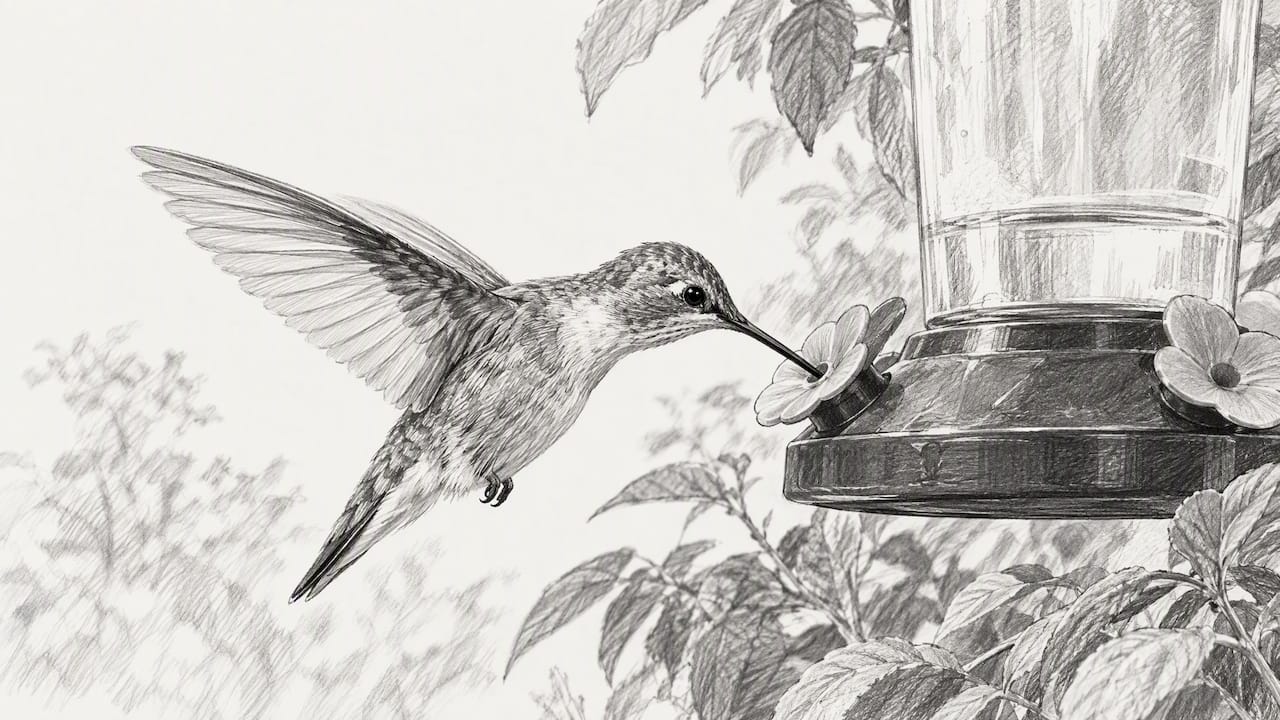
The best-known example for many US viewers is the Panama Hummingbird Feeder Cam run by the Cornell Lab of Ornithology, which sits on the grounds of the Canopy Tower, about 35 miles north of Panama City in Soberanía National Park. Because it is in a tropical forest, it shows species you will never see at a US feeder.
What feeder cams do well:
- Plenty of activity within minutes of tuning in, when the feeders are stocked.
- Good for learning to tell species, sizes and behaviors apart.
- Often useful for ambient viewing: some provide sound from the surrounding habitat.
What they do badly: they reveal little about natural nesting or foraging, because the food is provided by people. Feeders also look busier than the surrounding habitat actually is.
Nest cams
A nest cam watches a single nest, typically one built by a wild female in a backyard shrub or tree. The nest is tiny, often compared to a golf ball or a walnut shell, so the footage can look very still for long stretches. Then a female arrives, feeds two chicks and settles again.
Timing is everything. For Allen's Hummingbird, one widely used species reference notes that nesting in southern coastal California can begin in early February and continue until mid-June, and it shows nestlings leaving the nest at about 21 days old. During autumn, many North American nest cams have finished their breeding coverage or show archives. This is a seasonal expectation, not a verified live-status report for any particular feed. Always read the provider's description before you assume you are watching something happening now.
What nest cams do well:
- A narrative arc: building, egg laying, incubation, chick growth, fledging.
- Calm, low-key viewing, good for classrooms and quiet breaks.
What they do badly: long stretches where little happens, and a real chance that a nest fails. Wild nests fail for many reasons, and a good provider tells viewers what to expect.
Why people watch hummingbirds on camera
Hummingbirds are hard to observe closely. They are small, fast and wary of people. Cornell alumni coverage of the lab's bird cams describes the cams as a kind of virtual field trip, letting viewers see natural behavior without disturbing the wildlife.
There is also real science in their movement. Berkeley researchers found that hummingbirds use a sideways flutter to get through small gaps, published in the Journal of Experimental Biology. On a good feeder cam you may see a bird tilt and shuffle around a branch or a feeder pole in a way that feels familiar once you know what to look for.
Watch for these behaviors:
- Hovering at the port. The bird stays almost still in the air while its tongue works.
- Territorial chases. One bird guards a feeder and drives others off. This is normal, not a sign something is wrong.
- Perching between sips. Many feeders have perches, and birds often rest on them.
- Quiet periods. A still bird or empty feeder cannot be assessed reliably from a webcam alone. Avoid disturbing birds or nests; direct welfare concerns to the operator or an appropriate wildlife professional.
How to check that a hummingbird cam is actually live
A webcam page can look active when it is not. Players freeze, providers pause streams for maintenance, and some feeds loop recorded clips. Before you spend an evening watching an empty feeder, run through this short check.
- Read the provider's page. The operator, not an aggregator, knows whether the stream is running, paused or in an off-season. Look for a status note or a date.
- Look for a clock or overlay. A timestamp that matches the current time in that location is the strongest simple signal. Compare it with the local time zone.
- Watch for natural change. Leaves moving, light shifting, a bird arriving. A frame that never changes is a red flag.
- Check day and night. A cam in Panama should be dark when it is night there. A bright, unchanging image at 2 a.m. local time suggests a loop or a frozen frame.
- Reload once. If the player is stuck, a refresh often fixes it. If nothing returns, the stream is probably offline.
- Look for recorded highlights. Many providers label clips clearly. A highlight reel is fine to enjoy, but it is not the current view.
We go deeper on this in our guides to checking whether a wildlife feed is live and to finding reliable live nature webcams.
Matching the cam to the season
Wild hummingbirds are native to the Americas. A webcam can let viewers elsewhere observe that habitat remotely; cameras showing captive birds may be located outside the native range. A feed shows conditions at one place and time, so it cannot promise sightings on future travel dates.
A rough guide to what to look for by period:
| Period | Where to look | What you may see |
|---|---|---|
| Late winter to early summer | Western US, especially coastal California | Nesting, if a provider runs a nest cam |
| Spring and summer | Much of the US and Canada | Feeder visitors, territorial males, nesting females |
| Late summer and fall | Southern US, Mexico, Central America | Migrants passing through, heavy feeder traffic |
| Year-round | Tropical sites such as Panama or Ecuador | Steady feeder activity, many species |
This table is a general pattern, not a promise. Weather, local conditions and each provider's schedule decide what is on screen on any given day.
If you want to browse by place, the United States webcam pages on GlobeWebcams list public cameras by location, and the national park webcam guide helps you find protected landscapes where hummingbirds may visit flowers in season. Our bird feeder cam guide covers the closest related type of stream.
Fall: why feeders and cams stay interesting
Many people believe hummingbirds will fail to migrate if feeders stay up. South Carolina's Department of Natural Resources says otherwise: migration is driven mainly by day length, not by whether food is available. Leaving feeders up into the fall can give late migrants a useful energy source when natural food is scarce.
That is why the autumn months can still produce good viewing on feeder cams in southern states and in Mexico and Central America, where birds from farther north pass through. If your local feeder cam has gone quiet, a provider in a warmer region may be busier.
If you want to feed hummingbirds yourself
Watching on a screen is the low-effort option. Many viewers eventually hang a feeder of their own, and some add a camera. Feeding done badly can hurt the birds, so follow guidance from wildlife agencies.
Nectar and cleaning
The US Fish and Wildlife Service's backyard bird feeding tips give a simple routine:
- Mix one part white sugar to four parts water.
- Change the nectar every 3 to 5 days, and more often in hot weather.
- Throw it out at once if it turns cloudy.
- Clean with hot water and a bottle brush. Do not use soap or detergent, which can leave residues. A diluted bleach solution (1 part bleach to 9 parts water) is the other cleaning option, followed by a thorough rinse.
- Let the feeder air dry fully before refilling.
If you are unsure about a feeder problem, such as mold in a hard-to-reach part, a local wildlife rehabilitator or your state wildlife agency can advise on your situation.
Predators and nest safety
Feeders can attract more than hummingbirds. An Ohio State University summary of research on feeders and nest survival says feeders can draw predators such as hawks and crows, but the relationship with nest success is complex and varies by species and local conditions. In other words, a feeder is not automatically good or bad for nearby nests. Placing it near cover, but not so near that predators can ambush visitors, is a reasonable approach, and checking how your own yard behaves is better than copying a rule.
A different way to see hummingbirds up close
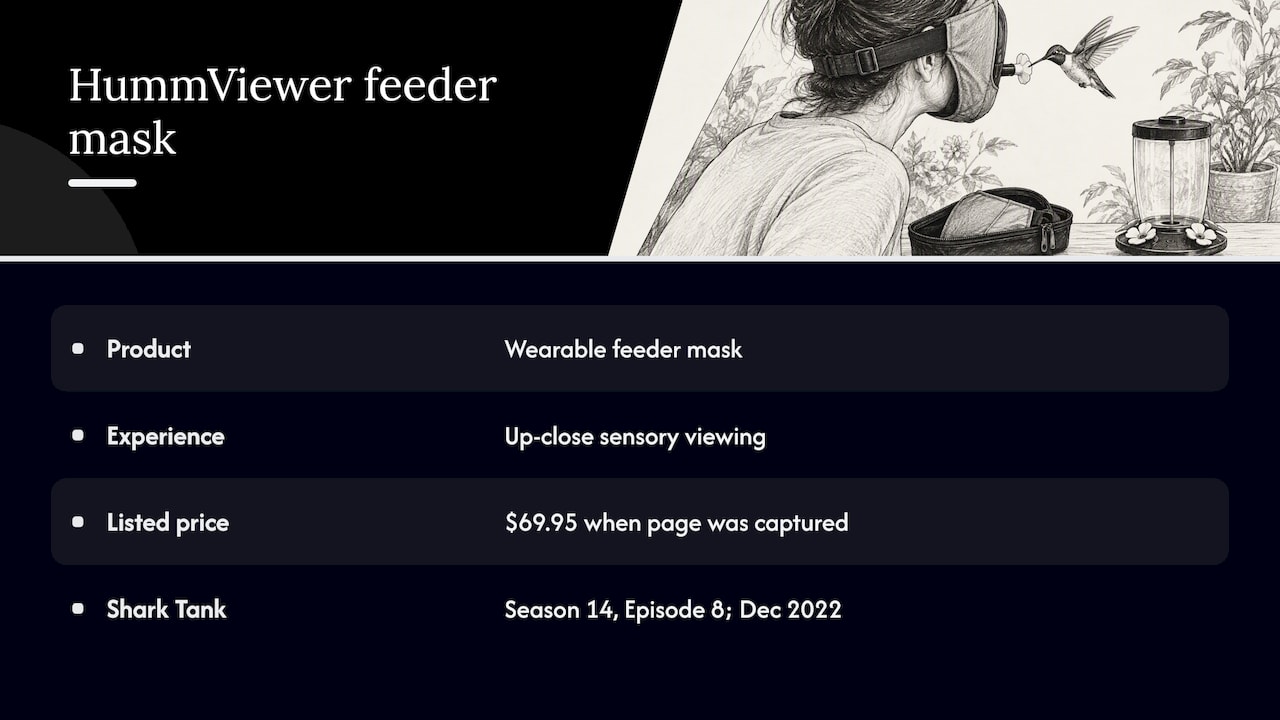
Some people want more than a screen. HummViewer makes a wearable feeder mask that puts a feeder close to your face so birds hover near you. It was featured in Season 14, Episode 8 of Shark Tank, which aired in December 2022. The company says it is designed to give viewers an up-close sensory experience of hummingbirds. Availability and price must be checked directly with the maker.
We do not sell or operate it, and it is not a replacement for a camera. It is simply another way people get closer to the birds. If you try anything like it, keep the same feeder hygiene rules above, and follow your local wildlife guidance.
Use cams for pleasure, not for decisions
Hummingbird cams tell you about birds. They should not be your only source for weather, roads, flights or safety. A sunny image from a feeder cam is not a forecast for the trail you plan to hike, and a dark frame does not mean a storm. For those decisions, use official weather services, park authorities and transport agencies.
Find hummingbird and other nature cams on GlobeWebcams
GlobeWebcams is a map-first directory of public and authorized webcams. We do not own or operate the cameras. Each page links back to the original provider, and we apply rights, availability and quality checks before publishing a page. You can start on the worldwide webcam map, narrow by country or category, and see our source list to understand where views come from.
If hummingbirds lead you to other wildlife, these guides help: zoo webcams, sea otter cams, puffin cams and underwater webcams.
Making the most of a viewing session
A few habits make the difference between a pleasant session and a frustrating one.
- Pick the right hour. Hummingbirds feed heavily in the early morning and late afternoon, so a quiet midday stream is not necessarily broken. Check the local time at the camera.
- Give it ten minutes. Feeder cams usually reward patience, and nest cams reward more of it.
- Use the provider's controls. Many operators offer highlights, chat or species notes, and these are the best way to know what you are seeing.
- Keep notes. If you like birding, jot down species, behaviors and times. It builds skill faster than casual watching.
- Respect the rules. Do not record, rebroadcast or repost a stream unless the provider allows it. Public access does not always mean permission to reuse.
For families and classrooms, a nest cam is a strong teaching tool, as long as the teacher knows the season. Choose a provider that explains the species and the timeline, and be ready to talk about what happens if a nest fails, because wild nests sometimes do.
FAQ
What is the best hummingbird cam to watch?
That depends on the season and what you like. For constant action, a feeder cam at a tropical site such as the Cornell Lab's Panama feeder cam is a dependable choice. For a nesting story, pick a nest cam only during its breeding season and confirm on the provider's page that it is running.
Can I watch a hummingbird nest cam in the fall?
Usually not a current nest in most of North America, because breeding has ended for the year. Providers may show archived clips instead, and those are not live. Check the page for labels and dates, or switch to a feeder cam.
How do I know a hummingbird cam is live?
Look for a timestamp that matches local time at the camera, natural movement such as leaves or light changes, and a status note from the provider. A frozen frame or a bright image at night suggests the stream is stuck or looped. Reloading once is worth trying.
How often should I change nectar in my own feeder?
The US Fish and Wildlife Service advises changing it every 3 to 5 days, and more often in hot weather, and discarding it if it turns cloudy. Use one part sugar to four parts water, and do not use soap when cleaning the feeder.
Does leaving a feeder up stop hummingbirds from migrating?
No. State wildlife officials say migration is triggered mainly by changing day length, so a feeder will not keep birds from leaving. It can help late migrants refuel.
Sources
- Panama Hummingbird Feeders, Cornell Lab Bird Cams
- Allen's Hummingbird breeding, Birds of the World
- Cornellians and bird cams, Cornell Alumni
- Hummingbirds' unique sideways flutter, Berkeley News
- Hummingbirds returning to South Carolina, SC Department of Natural Resources
- Backyard Birds: Feeding Tips, US Fish and Wildlife Service
- Study finds complex relationships among bird feeders, predators and nest survival, Ohio State University
- Businesses and products from Shark Tank Season 14, Episode 8, ABC
- HummViewer
Recommended
- Watch Bird Feeder Cams Tonight, Streams, Setup…
- Puffin Cams: Seasonal Viewing and How to Verify…
- Owl Nest Webcams: Four Stages and How to Verify…
- Wildlife Webcams: Check Whether a Feed Is Live…
Webcam availability and conditions can change without notice. GlobeWebcams does not operate most listed cameras; feeds and imagery remain under the control of their original providers. Do not rely on webcam imagery alone for weather, road, travel or safety decisions.